A Dark, Cinematic Fine-art Portrait Of The Joker, Rendered A...
Category: General | Model: Stable Diffusion
A Dark, Cinematic Fine-art Portrait Of The Joker, Rendered A...
Prompt Text
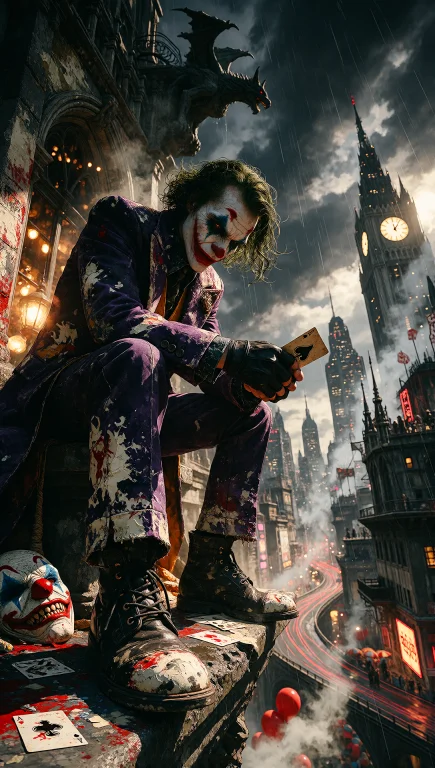
A dark, cinematic fine-art portrait of the Joker, rendered as a dramatic contemporary oil painting with heavy impasto, thick layered pigment, expressive brushstrokes, aggressive palette-knife marks, scraped paint, and richly tactile canvas texture. Combine the atmosphere of a dark noir graphic novel with the grandeur of a monumental oil painting, balancing realistic detail with raw, chaotic painterly expression. The Joker is the only character in the entire image, sitting theatrically on a grotesque stone gargoyle atop a towering Gotham skyscraper. He occupies the immediate foreground and dominates the composition. One leg hangs casually over the edge while the other is bent beneath him. He holds a single weathered Joker playing card in one hand and gazes silently over Gotham as though watching a private performance. His posture is relaxed, elegant, theatrical, and deeply unsettling. His appearance is iconic yet realistic: pale weathered clown makeup, darkened eyes, an unnervingly wide red smile, chaotic green hair, and an elegant but slightly disheveled deep-purple suit with subtle green and muted orange accents. Rain disturbs the makeup and darkens the fabric. His expression combines amusement, intelligence, theatrical joy, unpredictability, and menace. Avoid cartoonish exaggeration; make him physically believable and psychologically disturbing. Below him stretches an immense Gotham City, a collision of decaying Gothic architecture and brutalist modernism—cathedral towers, gargoyles, abandoned clock towers, pointed arches, narrow alleys, monumental concrete structures, industrial rooftops, elevated highways, monolithic skyscrapers, and densely packed buildings disappearing into rain and fog. The city should feel ancient, oppressive, empty, and melancholic, rather than colorful or futuristic. There are no neon lights, no neon signs, no glowing advertisements, and no futuristic illumination. Distant windows emit only faint, natural-looking warm amber, pale yellow, and cold white light, partially obscured by rain, smoke, and atmospheric haze. Wet rooftops and streets reflect only these restrained sources of illumination. The atmosphere contains subtle traces of Joker-related history without depicting his image anywhere else: a few discarded playing cards caught in puddles, a weathered clown mask lying on a distant rooftop, torn theater posters, broken carnival lights, faint graffiti marks, scattered red balloons disappearing into the fog, and evidence of urban disorder. These elements must remain small, distant, and secondary. Do not depict the Joker, Joker faces, clown faces, Joker portraits, Joker symbols, Joker statues, Joker projections, Joker billboards, Joker graffiti portraits, or any other representation of the Joker anywhere except the single Joker character in the foreground. There are no hanging flags, banners, posters, signs, projections, murals, screens, or advertisements displaying the Joker or his face. The distant Gotham skyline should remain visually independent from the character, allowing the Joker's silhouette to be the sole human focal point. The sky is immense and oppressive: dense charcoal and violet-black storm clouds, rain, smoke, drifting fog, atmospheric turbulence, and subtle distant lightning. The clouds should be rendered with thick expressive impasto, creating enormous depth and movement. Lighting: cinematic and low-key, dominated by deep blacks, charcoal shadows, muted moonlight, faint warm window light, and subtle cold illumination from the overcast sky. A soft rim of cold light outlines the Joker's shoulders and green hair, while restrained warm light catches portions of his face, hands, and purple suit. His white face and red smile remain the primary visual focal point. Color palette: near-black, charcoal, graphite gray, deep violet, bruised purple, muted emerald green, dirty ivory, pale white, restrained crimson, tarnished gold, smoky blue, and subtle amber. No neon colors and no artificial glowing effects. Overall saturation should remain low, sophisticated, dark, and cinematic. Composition: vertical cinematic portrait, dramatic low-angle perspective from slightly behind and beside the Joker. He dominates the upper-middle foreground while the enormous Gotham skyline falls away beneath him. Strong diagonal lines from rooftops and architecture lead toward the distant city and storm clouds. Generous atmospheric negative space surrounds the figure. The image should feel like a gigantic abandoned theatrical stage, with the Joker as the solitary performer standing above the silent city. Visual style: dark contemporary oil painting, cinematic concept art, neo-noir, gothic romanticism, psychological horror, graphic-novel sensibility, sophisticated chiaroscuro, painterly realism, brutalist architecture, dramatic environmental storytelling, realistic materials beneath expressive paint, volumetric fog, wet reflective surfaces, intricate architecture, visible individual brushstrokes, textured canvas, high-detail masterpiece. Key emphasis: The Joker is the only visible character and the sole embodiment of chaos. Gotham itself should never literally depict him. The city merely reflects his presence through atmosphere, abandoned objects, decay, rain, and subtle traces of disorder. He sits alone above the immense darkness, silently smiling at Gotham below. Negative emphasis: no neon, no neon signs, no glowing advertisements, no holograms, no colorful futuristic lights, no hanging flags, no Joker banners, no Joker portraits in the background, no Joker statues, no Joker projections, no additional characters, no crowds in focus, no duplicated Joker, no second Joker, no cartoon imagery.