A Dark, Cinematic Horror-science Laboratory Fills The Frame,...
Category: General | Model: Stable Diffusion
A Dark, Cinematic Horror-science Laboratory Fills The Frame,...
Prompt Text
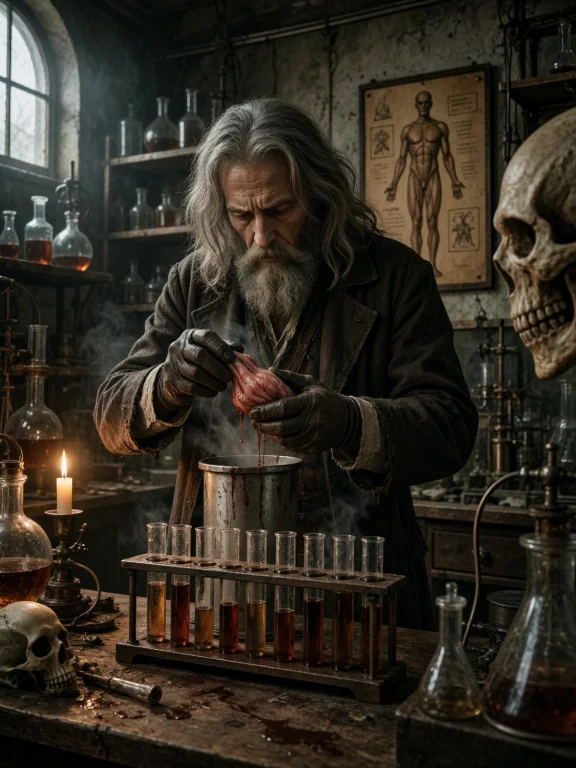
A dark, cinematic horror-science laboratory fills the frame, rendered in highly detailed realistic style with heavy shadows, warm candlelight, and cold daylight streaming from a tall arched window on the upper left. The environment appears old, decayed, and industrial, with cracked plaster walls, exposed brick, stained surfaces, aged wood, dust, grime, steam, and corroded metal throughout. In the upper-left area, the window has irregular vertical panes and pale bluish-white light shining through, creating strong backlighting against the dim interior. Beneath and around the window are silhouettes of laboratory apparatus, glass cylinders, pipes, shelves, and dangling wires, all partially obscured by haze and smoke. Across the upper and middle background, multiple shelves hold many transparent glass flasks, round-bottom bottles, jars, test tubes, and scientific vessels. They vary in size from small vials to larger spherical containers, with reflective highlights on their curved glass surfaces. Several bottles contain dark red-brown liquid or residue, while others appear empty or cloudy. Metal frames, vertical supports, hanging cables, and suspended mechanical parts add to the cluttered alchemical workshop atmosphere. The rear wall is mottled beige, brown, gray, and black, with peeling paint, stains, cracks, and age-darkened textures. In the central foreground, an elderly male scientist dominates the composition. He appears Caucasian, roughly late 60s to 70s, with a gaunt build, deeply wrinkled pale skin, pronounced cheekbones, sunken eyes, sharp facial contours, and an intense, sinister expression. His face is narrow and angular, with heavy wrinkles across the forehead and around the eyes, visible under-eye folds, and a stern, downward-turned mouth. He has long, messy, wavy gray hair spreading outward around his head and a thick unkempt gray beard and mustache. He wears layered, ragged, dark earth-toned clothing resembling a worn coat, vest, shirt, and suspenders or straps. The fabric looks dirty, frayed, torn, and stained, with a rough linen or wool texture. He also wears dark leather or rubber gloves, adding to the clinical yet brutal appearance. His posture is hunched forward over the workbench, shoulders angled down, head tilted slightly toward the specimen in his hands, conveying obsessive concentration. The scientist is positioned directly behind a rack of glass test tubes placed near the center-lower portion of the image. He holds a fleshy organ or biological specimen with both gloved hands above a cylindrical metal container filled with murky reddish liquid. The specimen is pinkish-red, moist, irregularly shaped, and glossy, with folds and cavities suggesting internal anatomy. Small streaks of red liquid and dark stains run from his hands down toward the container below. The metal container beneath it sits on the wooden bench and shows a circular rim, worn reflective surface, vertical red smears, and dripping blood-like drops falling into the vessel. Steam or vapor rises faintly from the heated-looking fluids, softening the lower central area. In front of the scientist, the test-tube rack occupies a prominent horizontal band across the lower-middle frame. It is made of dark metal and contains numerous tall transparent tubes arranged upright in a row. The tubes contain different amounts and colors of liquid, including clear, amber, reddish-brown, deep maroon, cloudy beige, and nearly black tones. Some tubes are capped or sealed at the top, while others show condensation, bubbles, residue, or uneven liquid levels. Additional narrow glass vessels, pipettes, clamps, and small mechanical fittings surround the rack. Thin metal rods, tubing, hooks, valves, and cable-like elements connect the apparatus, forming a dense network of scientific instruments. The glass surfaces catch highlights from the candles and window, producing bright specular reflections against the otherwise dark palette. On the left side of the workbench, several additional laboratory objects appear in the foreground. There are tall glass cylinders with water droplets or condensation, a bulbous flask containing amber liquid, a dark metal burner-like device with a small bright flame or glowing element, coiled cables, small jars, and scattered fragments of apparatus. The tabletop is wooden, heavily worn, scratched, stained, and splattered with dark red and brown marks. Near the lower-left corner, skulls and skeletal materials rest on or near the bench, including a pale skull lying horizontally with hollow eye sockets and weathered bone texture. These bones reinforce the macabre, anatomical theme and sit in partial shadow beside the glowing lab lights. Behind the scientist on the right-center wall, a large rectangular anatomical drawing or parchment-style chart hangs vertically. It is tan-brown like aged paper or corkboard, pinned or mounted within a dark frame-like border. The drawing depicts a muscular human-like torso and limbs in sepia linework, with surrounding technical sketches, measurement-like markings, small boxes, diagram panels, and handwritten annotation lines. A dark anatomical figure or skeletal drawing is centered on the board, and the surrounding notes appear too small and indistinct to read clearly. Below and beside the board are more shelves, bottles, hanging cords, dark mechanical devices, and shadowed equipment. The parchment adds a historical medical-illustration quality to the laboratory setting. The right side of the image contains a large blurred skull-like or monster-like head occupying the far-right foreground edge. It is oversized relative to the scene, with a craggy, pitted, bone-colored surface, deep holes, jagged ridges, and irregular organic contours. Its shape resembles a decayed skull, creature head, or grotesque preserved specimen. Because it is out of focus and cropped by the frame, it functions as a looming visual threat, facing inward toward the scientist and workbench. Behind it, the background fades into dark shelves, shadowed figures or forms, pipes, and indistinct lab equipment. Lighting is dramatic and high contrast. Cool daylight from the upper-left window outlines the misty air and silhouettes equipment, while warm orange candle flames glow on the lower-left bench, casting amber highlights on glass, wood, and metal. Shadows are deep and blackened along the corners, especially the upper-left equipment area and the right-side background. The color grading emphasizes muted browns, blacks, olive grays, rust reds, bone ivory, and sickly yellow-green accents. Smoke, steam, dust, and reflective moisture create a damp, claustrophobic atmosphere. The composition is a close-to-medium cinematic shot, likely photographed or digitally rendered from a slightly low frontal angle. The scientist is the central focal point, framed by the arched window and shelves behind him, with the test tubes aligned in front of his torso and the grotesque skull pressing in from the right edge. The depth of field keeps the central figure, specimen, and test tubes relatively sharp while pushing the foreground skull and some background machinery into blur. The overall aesthetic is gothic horror, Victorian-steampunk laboratory, and dark biomedical experimentation, with meticulous texture detail, dramatic chiaroscuro, and visceral body-horror imagery.