A Highly Realistic, Observational Documentary Photograph Tak...
Category: General | Model: Stable Diffusion
A Highly Realistic, Observational Documentary Photograph Tak...
Prompt Text
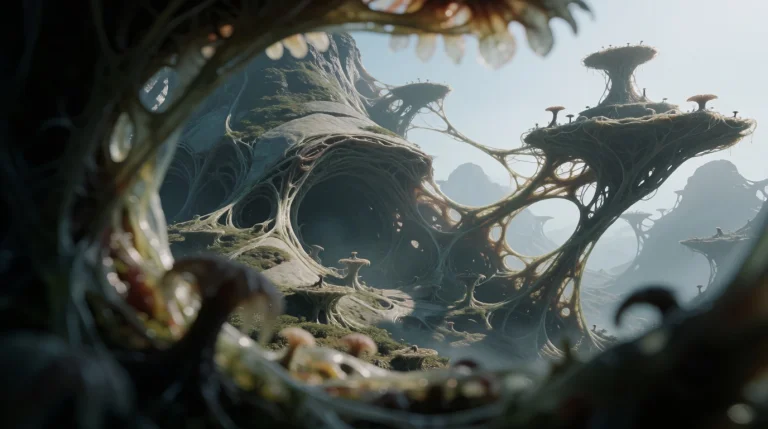
A highly realistic, observational documentary photograph taken from the perspective of an explorer standing directly on the surface of an entirely alien living planet. The image must feel like an authentic scientific expedition record: physically believable, imperfect, and quietly astonishing, avoiding spectacle or fantasy concept art aesthetics. The composition guides the eye naturally from extreme foreground to distant background, establishing deep immersion. In the extreme foreground, unfamiliar biological plants and structures partially obscure the view, appearing as dark, softly blurred silhouettes slightly out of focus. These elements frame the scene, suggesting the viewer has just pushed them aside to look through them. They are not the subject but serve to establish physical presence and depth. The materials here are fleshy, fibrous, and slightly translucent, with visible moisture and organic textures. The main focal point is a colossal living mountain formation in the middle distance. It is dominated by layered biological tissue, dense fibers, membranes, pores, and enormous vascular structures. The surface alternates between taut, smooth sections and weathered, fibrous areas. A large, cave-like opening serves as a secondary visual anchor, partially mysterious and formed from thick living tissue and organic folds rather than rock. Deep inside, faint biological structures disappear into darkness, creating a sense of scale and internal complexity. The viewer initially perceives a cave before realizing it is an organ. Off to one side, floating biological platforms create a strong secondary visual rhythm. These are naturally grown pieces of the planet, suspended in the atmosphere, connected by long, organic filaments resembling veins or tendons. The connections are wet, translucent, irregular, and slightly viscous, leading the eye through the scene in an asymmetric, organic network. A variety of scales are present, from tiny isolated platforms to one significantly larger formation supporting a miniature ecosystem. The platforms appear to be actively generating new structures, with branches extending into smaller offshoots. The background dissolves into atmospheric haze, showing distant living mountains and enormous biological structures fading into mist. The horizon is not perfectly clear but defined by atmospheric perspective, making the landscape feel immense and ongoing. The background remains quieter and less detailed than the middle ground, reinforcing the enormity of the main subjects. Tiny alien creatures are scattered throughout, partially hidden among structures and platforms. They have no legs and no recognizable terrestrial anatomy, appearing small enough to reinforce the planet’s scale. Some look directly toward the camera. Subtle signs of biological activity are visible: a faint pulse beneath translucent tissue, moisture on membranes, slowly contracting openings, and faint internal illumination. The entire geography feels alive, suggesting it is part of one enormous living organism. The color palette is original and restrained, avoiding stereotypical neon sci-fi. It features deep organic tones, mineral hues, translucent tissues, and subtle luminous accents. Lighting establishes a clear hierarchy: the living mountain receives the clearest natural illumination, the floating platforms catch secondary highlights, and the foreground remains darker. Atmospheric scattering, depth of field, natural shadows, and physically convincing material response complete the realistic, documentary aesthetic. The image reads as a scientific observation of impossible biology in a quiet, awe-inspiring setting.