A Single Coloring-book Page Showing One Girl And Her Cube-sh...
Category: General | Model: Stable Diffusion
A Single Coloring-book Page Showing One Girl And Her Cube-sh...
Prompt Text
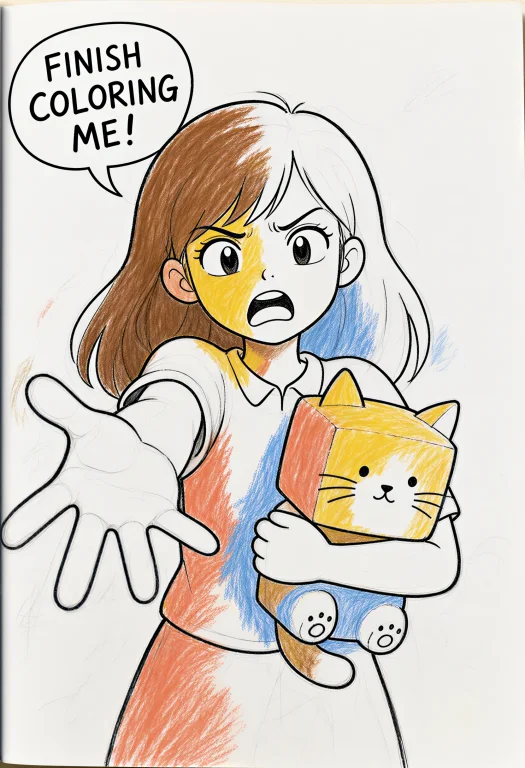
A single coloring-book page showing one girl and her cube-shaped cat stuffed animal, drawn as a visibly unfinished illustration that has become aware it is incomplete. The girl faces directly out of the page and breaks the fourth wall with an impatient, pleading expression: wide eyes fixed on the viewer, brows raised and pinched, mouth open mid-demand. One arm reaches toward the viewer, palm up and fingers spread in an unmistakable “come on, finish this” gesture; her other arm keeps the plush cat tucked against her side. A large hand-drawn speech bubble above her reads, “FINISH COLORING ME!” The lettering is simple, bold, girllike, and legible, with the bubble’s tail clearly pointing to the girl. The girl and plush are the only characters; no extra figures or scene narrative. Treat the entire image as a page from a girls’s coloring book that a girl has only partly colored before losing interest. The main outlines are thick, imperfect black ink, with occasional wobbles, doubled strokes, tiny gaps, and lightly visible pencil construction marks. Keep the figures simple and readable, with rounded shapes, clear silhouettes, expressive faces, and the clean open spaces of a printable coloring-book drawing. The girl has an anime-influenced face expressed through simple line-art features, large eyes, small nose, and a wide expressive mouth, but the finished image must read as a coloring-book page, not polished anime art. Her hair falls around her face in broad, distinct locks; she wears a plain short-sleeved outfit with a simple collar and uncomplicated folds, leaving generous areas for coloring. The stuffed animal is unmistakably a cat rendered as a soft cube: a rounded square body, small triangular ears, simple whiskers, dot-like paws, and a little stitched face. It looks like a plush toy, not a living cat or a hard geometric object. Make the unfinished state immediately visible. Roughly half of the girl’s hair, face, clothing, and the stuffed cat have been filled with color, while the remaining areas are blank white paper with black outlines and a few faint sketch lines. Let the boundary between colored and uncolored areas cut across recognizable forms rather than neatly dividing the image into separate halves: one cheek is colored and the other left white, some hair locks are filled while neighboring locks remain empty, and one sleeve is colored while its mate is unfinished. A portion of the cat’s cube body has color, but much of its face and one ear remain plain paper. The transition should feel accidental and girl-made, not like a precise split-screen effect. Leave some contours partly drawn, with a few features ending in visible, tentative pencil strokes, as if the illustration itself has not been completed. The colored sections should look hasty and uneven. Use broad crayon or wax-pencil strokes with visible grain, short overlapping scribbles, uneven pressure, small uncolored islands, and patchy areas where the paper shows through. Let color cross the black contours in several obvious places, especially at the hairline, sleeve, cheek, and edges of the cube plush. Include a few soft smudges and faint stray marks near the colored areas, as though a girl’s hand dragged pigment across the paper. Some colors may be layered unevenly or rubbed thin, but keep the girl’s expression and the cat plush easy to read. Choose a small, cheerful range of ordinary coloring-pencil colors, such as warm brown, yellow, coral, and soft blue, applied inconsistently, with no sophisticated palette or carefully blended shading. Leave the rest of the page predominantly white. Compose the page as one frozen, front-facing moment. The girl occupies the center and is large enough for her demanding expression and reaching hand to be immediately clear; the plush cat is visible against her side rather than hidden behind her arm. Her gaze meets the viewer, and the reaching hand projects slightly forward through simple perspective, without obscuring her face. Keep the composition contained within the page, with open white paper around the figures and a few light, uneven pencil marks near the edges. The scene should feel like the character is urgently addressing the person looking at the drawing, while remaining visibly just ink and crayon on paper. Use flat paper-based marks only: no glossy rendering, digital gradients, cinematic lighting, painted background, realistic depth, decorative effects, polished coloring, or clean vector finish. The defining visual contrast is between the expressive, self-aware girl and the cat plush, and their plainly unfinished, sloppily half-colored coloring-book appearance.