A Surreal Retro-futuristic Architectural Marvel Rises From A...
Category: General | Model: Stable Diffusion
A Surreal Retro-futuristic Architectural Marvel Rises From A...
Prompt Text
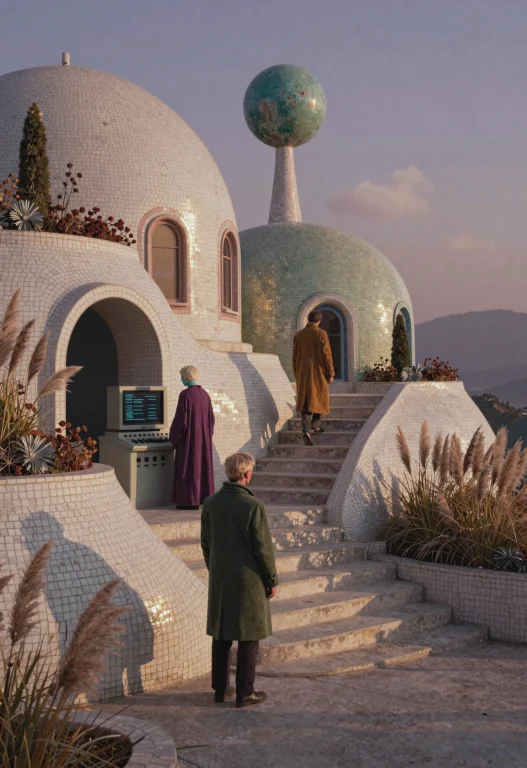
A surreal retro-futuristic architectural marvel rises from a sun-drenched plateau, its form both ancient and otherworldly—a symphony of pale off-white mosaic tiles arranged in vast terraced layers that cascade upward like frozen waves. Each step is carved with meticulous precision, the tiles glowing faintly under a low-angle golden hour light that slants across the scene from the left, casting elongated shadows that stretch like silent prayers toward the distant horizon. Embedded within the structure are three colossal ovoid domes: one soft ivory kissed by a blush of warm rose along its lower curve; another a serene pale sage green, its upper rim catching a liquid sheen as if reflecting a memory of water; and a central, towering verdigris teal sphere perched atop a slender obsidian spire—its surface pitted with age, streaked with mineral patina like forgotten scripture. The domes are not perfect; their subtle elongation gives them a living quality, as though they breathe in time with the earth. Tall rounded archways pierce the mass of the building, their interiors swallowed by cool blue-grey shadows that contrast starkly against sunlit terraces, creating deep chiaroscuro effects that heighten emotional tension. Narrow rectangular windows—some glowing faint amber from within, others dark and closed—punctuate the tiled façade like dormant eyes, each one a silent portal to unseen lives. A wide flight of shallow steps winds through the composition, flanked by low retaining walls lined with dried rust-colored flowers and silvery foliage, their brittle forms suggesting time passed and rituals performed in silence. Sculpted topiary shrubs in muted olive tones stand rigidly upright on each terrace, their rounded shapes clipped to perfection—monuments of order in a landscape that whispers of forgotten purpose. Clusters of tall, dusty beige pampas-like grasses rise from planter boxes at the edges, their delicate plumes swaying faintly in an unseen breeze, adding soft vertical movement to the otherwise still composition. In the distance, a hazy mountain range dissolves into a dusky lavender-grey sky that fades seamlessly into a warm dust rose near the horizon, where even the clouds are thin and spectral—wisps of memory drifting behind the highest dome. Three adult Caucasian figures populate the space, each seen from behind or in profile, their faces obscured to deepen mystery: one at the base, standing motionless on the lower terrace in a heavy forest-green tweed overcoat with visible weave, collar turned up, hair short and fair, skin glowing faintly in the low sun; another beside a weathered control console, wearing a flowing aubergine plum linen robe that drapes in soft folds, head tilted toward a cathode-ray tube screen displaying scrolling lines of pale cyan text on black—its glow casting cool light across their pale blonde nape; and a third ascending the steps from above, seen mid-stride in a corduroy ochre coat with pronounced vertical ridges, short dark-blonde hair just visible at the back of the neck. The control panel itself is a relic: old-school dials, square push-buttons arranged in perfect grid, one small red indicator glowing like a heartbeat near the top corner—no digital interface, no screens, only analog presence. The color palette is restrained and deeply atmospheric: ivory, sage, teal, forest green, plum, ochre, dusty lavender—all slightly desaturated yet richly textured, evoking late-1970s editorial film with its grainy depth and warm cream shadows. Soft halation blooms gently around the brightest highlights on the domes where sunlight strikes—luminous flares that seem to pulse with quiet energy. The entire image is rendered in photorealistic precision: every mosaic tile, each thread of fabric weave, the edge of a button, the grain of weathered concrete—all sharp and tactile despite the dreamlike haze. A medium telephoto lens compresses perspective slightly, enhancing symmetry while allowing asymmetrical tension through figure placement. Deep leading lines formed by the steps draw the eye upward toward the archways and domes—toward mystery, toward transcendence. The atmosphere is reverent: a monastery of the far future where technology has aged into ritual, where silence speaks louder than words. No text, no logo, no signage—only architecture, light, shadow, and solitude. The sky gradient transitions smoothly from pale lavender at zenith to warm dusty rose near the horizon, with faint clouds drifting behind the highest dome like slow thoughts in a sleeping mind. The foreground ground is smooth concrete, subtly weathered by time, its surface unbroken save for the soft footprints of no one. No birds, no movement—only stillness that hums with meaning. This is not just architecture; it is emotion made visible—a moment suspended between past and future, where wonder lives in texture, light, and absence. A masterpiece of editorial photography: a museum-quality, clean presentation devoid of overlays, pure in form, profound in feeling. Every surface tells a story—cracks in the mosaic, frayed edges on fabric, the faint patina on metal. The play of light isn’t just illumination; it’s narrative. Shadows are not absence but presence—a language spoken through depth and weight. The domes seem to hum with latent energy, their surfaces absorbing centuries into their very atoms. Time here is not linear—it spirals, folds back upon itself in the curves of the terraces. The figures are not actors—they are relics themselves, part of the architecture’s memory. Their stillness isn’t emptiness; it’s fullness—the silence before revelation. The air feels thick with unspoken devotion, as if this place is a cathedral built not for worship but for remembrance. The pampas grasses move not from wind but from time—each sway a breath of history. Even the control console, so archaic in design, holds power—not through function, but through ritual. It’s not broken; it’s preserved. Not obsolete; it’s sacred. The ochre coat’s corduroy ridges catch light like topographical lines on an ancient map. The plum robe flows as if gravity is softer here, slower. The green tweed overcoat feels like armor forged from memory. No one speaks because words would shatter the stillness—this moment is too fragile for language. Light doesn’t just fall—it lingers, pools in corners, folds around domes like a prayer. Every tile reflects not sunlight but time’s reflection. This is an image that does not seek attention; it demands reverence. It exists outside of context, beyond explanation. The viewer is not looking at a photograph—they are standing within one. And yet, no footprints lead anywhere. No doors open. Only the architecture remains—eternal, questioning, alive in its silence. Atmospheric fine-art photography with the quality of a museum gallery print: luminous volumetric light, deep layered atmosphere, rich contrast between deep shadows and glowing highlights, refined color grading with vivid accents against muted tones, crisp fine detail and tactile real textures, real camera optics, captured in camera.