A Vertically Oriented Artwork Shows A Dense Monochrome Red C...
Category: General | Model: Stable Diffusion
A Vertically Oriented Artwork Shows A Dense Monochrome Red C...
Prompt Text
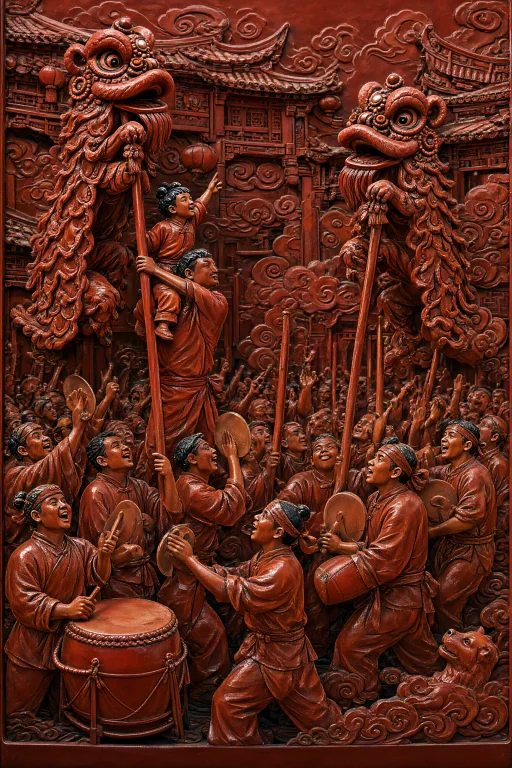
A vertically oriented artwork shows a dense monochrome red carved relief scene of a traditional lion dance festival, rendered as if cut from glossy lacquer or carved wood. The entire image is dominated by deep cinnabar red, burnt sienna, dark burgundy shadows, and thin black incised lines that define contours, folds, scales, facial features, clouds, and architectural details. The surface looks polished and layered, with raised cut edges catching highlights and black shadow lines revealing the depth of many carved layers. At the top and upper background, an ornate temple-like street façade fills the scene with stacked rooflines, curved eaves, bracket-like decorative structures, lattice panels, beams, beams ends, and repeated arched roof tiles. The architecture is highly detailed, symmetrical in its carved rhythm but visually busy, with every roof tier and column rendered in the same red material. Large rounded lantern-like forms and drum-like domes hang among the roof details, while swirling carved cloud motifs stretch across the upper sky area as raised spiral bands. On the upper-left portion, a large lion dancer head is mounted high on a long vertical pole. The lion has an open mouth, large round eyes, a broad nose, curled mane, expressive ears, layered bead-like facial ornaments, and raised paws gripping decorative tassels. Its body is elongated and sculptural, with carved folds in the costume, curled tail details, and polished red highlights along the contours. The pole rises from the lower crowd area toward the roofline, visually connecting the animal to the festival performance below. Near the center-left upper area, a small child stands on an adult’s shoulders or elevated seat beside the lion pole. The child has a small round face, dark carved hair gathered into rounded topknot-like shapes, a red traditional outfit, short sleeves, pants, and shoes. The child reaches one arm upward toward the lion’s head, creating a direct interaction between the performer and the animated figure. The adult beneath the child appears in profile, with a carved side-facing face, short dark hair, a red robe with broad sleeves, and sturdy legs; one arm supports the child while the other steadies the pole. On the upper-right side, a second large lion dancer head mirrors the left one in scale and complexity. It faces inward toward the center, with an open mouth, protruding eyes, curled mane, rounded ears, ornate beadwork, and raised paws holding tassel decorations. The lion stands on a long pole, with its body and pole descending into the middle of the crowd. Its carved surface includes layered scales, curled cloud-like mane forms, tassels, and glossy red lacquer highlights. Behind and around it, the background remains packed with carved architectural beams, roof ornaments, and swirling cloud reliefs. Across the lower half, a dense crowd of festival participants and spectators fills the street scene. The figures are carved in profile or three-quarter view, wearing traditional red clothing with robe-like jackets, tied sashes, headbands, caps, and flowing sleeves. Their faces are simplified but expressive through carved noses, mouths, cheek lines, eye shapes, and head contours. Several men hold long pole-like objects vertically, while others raise hands, cymbals, drumsticks, or clappers. In the lower-left and lower-middle areas, performers and spectators are packed closely together, with overlapping shoulders, raised arms, and smiling or shouting expressions suggested by carved open mouths and lifted chins. Large round drums occupy the lower-left foreground, their circular rims, rope-like struts, and cylindrical bodies rendered in raised relief. Nearby, other musicians hold cymbals and percussion instruments; their hands are open or mid-strike, suggesting loud drumming and cymbal-playing during the lion dance. The lower-right foreground includes another large drum held at chest height by a performer in a headband. The drummer’s carved profile faces left toward the performance area, with an open mouth and raised posture. Beside him, another participant carries a small drum or clappers and reaches forward with extended arms. Around them, carved smoke-like cloud puffs curl through the crowd and along the street, reinforcing the sense of firecrackers, drums, and festive movement. At the bottom-right edge, a small carved dog-like animal head or lion-like figure appears in profile, with pointed ears, a rounded muzzle, and glossy raised contours, surrounded by swirling cloud carvings. The scene is framed by a dark red base or shadowed ledge along the bottom edge, while the entire composition has the dimensional quality of a hand-carved lacquer panel. The composition is crowded, joyful, and theatrical: two raised lion performers dominate the upper left and upper right, the child on shoulders reaches toward the left lion at the center, and the surrounding crowd of musicians and spectators creates a rhythmic base of drums, cymbals, poles, and celebratory gestures. The lighting appears to come from the upper left, producing bright red highlights and deep black shadows along carved edges, making the relief look rich, glossy, and deeply layered. The image is a single ornate festival scene with no visible banners, modern signage, or written text; all information is conveyed through sculptural figures, architecture, instruments, smoke, and decorative cloud motifs.