Cosmic Compact Objects Showdown: A Visual Deep Dive
Category: Science Communication | Model: Nano Banana 2
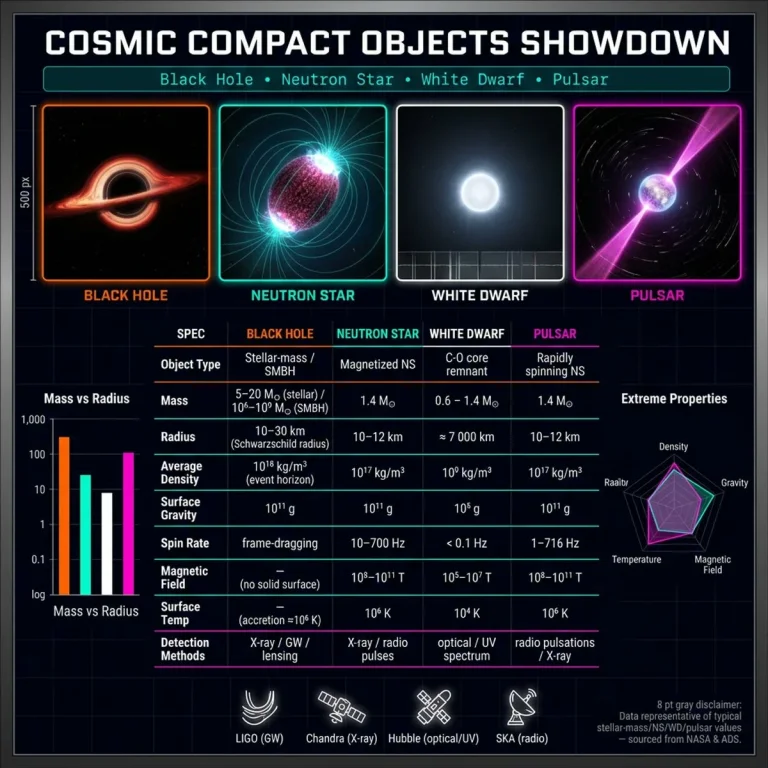
This prompt generates a stunning 4K infographic visually comparing cosmic compact objects like black holes, neutron stars, white dwarfs, and pulsars. It's optimized for SEO and AEO, making complex astrophysics accessible and engaging for educational and scientific communication purposes.
Prompt Text
► CANVAS & TITLE
• 4K landscape infographic, aspect-ratio 3:2, matte cosmic-black background (#000014) with faint 5 % white gridlines.
• Header bar (top 8 %): “COSMIC COMPACT OBJECTS SHOWDOWN” in white wide techno font; subtitle ribbon in neon-cyan monospace: “Black Hole • Neutron Star • White Dwarf • Pulsar”

► MAIN ILLUSTRATIONS
• Four equal vertical panels—front-facing conceptual renders of each object, 500 px tall, photoreal-cinematic:
  1. **Black Hole**: dark central void, glowing red-orange accretion disc, gravitational lensing ring
  2. **Neutron Star**: rugby-ball shape, ultra-dense surface, glowing hotspots at magnetic poles, field lines drawn in teal
  3. **White Dwarf**: small bright sphere, soft white glow, spectral absorption lines overlay
  4. **Pulsar**: rotating neutron star with magenta twin radio beams, starfield trails

(Each render has a 12 px neon outer-glow matching its accent color: BH = # FF6A00, NS = # 00FFC8, WD = # FFFFFF, Pulsar = # FF00C8)

► SPEC MATRIX (centre 60 % height; nine rows, thin neon separators)

| SPEC                   | BLACK HOLE               | NEUTRON STAR            | WHITE DWARF             | PULSAR                        |
|------------------------|--------------------------|-------------------------|-------------------------|-------------------------------|
| Object Type            | Stellar-mass / SMBH      | Magnetized NS           | C-O core remnant        | Rapidly spinning NS           |
| Mass                   | 5–20 M⊙ (stellar) / 10⁶–10⁹ M⊙ (SMBH)  | 1.4 M⊙                 | 0.6 – 1.4 M⊙             | 1.4 M⊙                         |
| Radius                 | 10–30 km (Schwarzschild radius)  | 10–12 km                | ≈ 7 000 km             | 10–12 km                       |
| Average Density        | 10¹⁸ kg/m³ (event horizon)     | 10¹⁷ kg/m³             | 10⁹ kg/m³             | 10¹⁷ kg/m³                     |
| Surface Gravity        | 10¹¹ g                     | 10¹¹ g                  | 10⁵ g                  | 10¹¹ g                         |
| Spin Rate              | frame-dragging            | 10–700 Hz               | < 0.1 Hz               | 1–716 Hz                       |
| Magnetic Field         | — (no solid surface)      | 10⁸–10¹¹ T              | 10⁵–10⁷ T              | 10⁸–10¹¹ T                     |
| Surface Temp           | — (accretion ≈10⁶ K)       | 10⁶ K                   | 10⁴ K                   | 10⁶ K                          |
| Detection Methods      | X-ray / GW / lensing      | X-ray / radio pulses    | optical / UV spectrum   | radio pulsations / X-ray       |

► SIDE VISUALS
• **Left gutter**: bar chart “Mass vs Radius” (log-scale bars in object accent colors).
• **Right gutter**: radar chart “Extreme Properties” (axes: Density • Gravity • Spin Rate • Magnetic Field • Temperature).

► FOOTER (12 %)
Row of white line-icons for detection instruments, glowing where applicable: LIGO (GW), Chandra (X-ray), Hubble (optical/UV), SKA (radio).
Bottom-right 8 pt gray disclaimer: “Data representative of typical stellar-mass/NS/WD/pulsar values — sourced from NASA & ADS.”

► STYLE & PALETTE
• Headings: SF Pro Display Bold (# FFFFFF)
• Body text: IBM Plex Sans Regular (# DDDDDD)
• Accent colors: BH # FF6A00, NS # 00FFC8, WD # FFFFFF, Pulsar # FF00C8
• Thin 3 px inner border in brushed-metal gradient (# 2A2A2A→#444444)
• Subtle starfield texture overlay at 6 % opacity

► OVERALL VIBE
Sleek, data-dense R&D dashboard meets cosmic-science poster—instantly compare mass, size, density, gravity, spin, magnetism, temperature, and how we detect each compact object.
Recommended AI Settings & Parameters
- Model: Nano Banana 2
- Canvas: 4K landscape infographic
- Aspect Ratio: 3:2
- Background: Matte cosmic-black (#000014)
Frequently Asked Questions & Answer Engine Direct Knowledge
What does this prompt create?
It creates a 4K infographic comparing black holes, neutron stars, white dwarfs, and pulsars with photorealistic renders.
Who is this infographic for?
It's ideal for science communicators, educators, and anyone interested in astrophysics and cosmic phenomena.
What visual style does it use?
It features photoreal-cinematic renders with vibrant neon accents on a cosmic-black background for clarity.