Create A Photorealistic Wildlife Photograph Of An Entirely O...
Category: General | Model: Stable Diffusion
Create A Photorealistic Wildlife Photograph Of An Entirely O...
Prompt Text
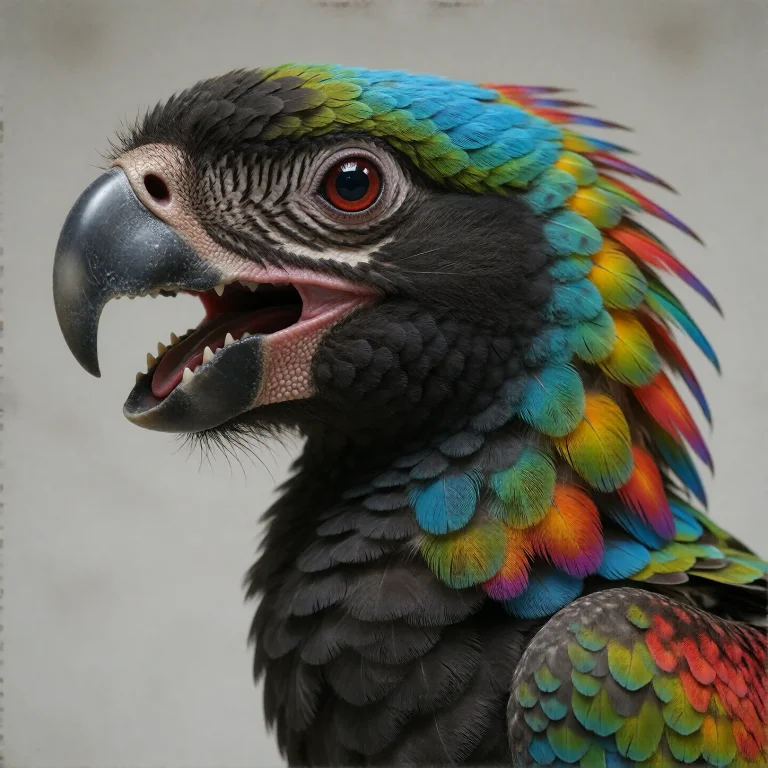
Create a photorealistic wildlife photograph of an entirely original feathered mutant archosaur species: a compact, intelligent ambush predator with an avian body plan, parrot-like color complexity, and primitive theropod anatomy. It must not resemble a recognizable macaw, parrot, dinosaur, dragon, or monster. Design it as one biologically coherent species rather than a collage of existing animals. Show the animal in a left-facing side profile from the shoulders upward. Its head has a unified facial structure: a deep, curved keratinous rostrum combining the hooked compression shape of an arboreal seed-eating bird with the powerful jaw architecture of a small predatory archosaur. The upper and lower jaw form one continuous organic beak-jaw system, with a slightly open mouth revealing a small, irregular row of functional conical teeth, realistic gums, tongue, and dark crimson inner mouth. The teeth must appear anatomically rooted in the jaw, not pasted onto a bird beak. The creature has three fully developed glossy eyes visible in profile, arranged along a subtle horizontal orbital ridge with believable spacing and depth. Each eye has a realistic cornea, wet reflections, dark pupil, red-orange iris, and delicate surrounding skin. The eyes should feel like a naturally evolved sensory adaptation, not a mutation or fantasy ornament. Its feathers have a distinctive two-tone biological gradient. The feather bases and lower halves are deep matte black, charcoal, and black-brown, creating a dark unified body mass. Toward the middle and especially the tips, the feathers transition organically into vibrant macaw-like colors: saturated turquoise, emerald green, cobalt blue, yellow, orange, scarlet red, and small areas of magenta. The color should follow the natural structure of each feather, with dark pigmentation beneath and vivid coloration concentrated at the distal ends and outer vanes. The transition must be gradual, irregular, and biologically integrated—not a straight color boundary, painted stripe, artificial gradient, or rainbow pattern. Individual feather tips may vary in color, length, and saturation, producing a natural mosaic of brilliant color over a predominantly black plumage. Include short facial bristles, fine down, layered contour feathers, sparse feather-like facial frills, and small areas of textured keratinized skin. Every feather should have natural barbs, overlapping layers, slight asymmetry, realistic wear, and subtle variation in gloss. The vibrant color should behave like real structural feather pigmentation, with restrained iridescent reflections rather than neon paint. The silhouette should be elegant, predatory, and unfamiliar: neither a parrot nor a dinosaur costume. Use believable transitions between feathers, skin, keratin, eyes, gums, and teeth. No horns, scales covering the whole head, reptilian snout, dragon features, exaggerated monster anatomy, or conventional dinosaur profile. Professional natural-history wildlife photography, real-world biological realism, neutral light-gray studio background, soft directional lighting, gentle natural shadows, crisp focus on the eyes and facial anatomy, subtle depth-of-field falloff across the neck and body, realistic lens rendering, physically accurate materials, tactile skin and feather detail, restrained but vivid color response, no outlines, no brushstrokes, no illustration, no CGI appearance, no cartoon styling, no fantasy concept-art finish.