Create An Extraordinarily Detailed,monumental Image Of The C...
Category: General | Model: SDXL
Create An Extraordinarily Detailed,monumental Image Of The C...
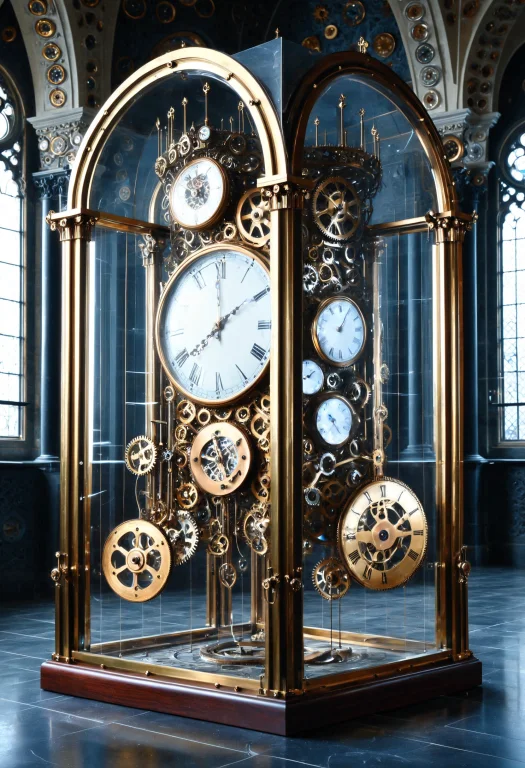
Prompt Text
Create an extraordinarily detailed,monumental image of THE CATHEDRAL OF TIME: a vast,silent cathedral built entirely from recognizable clocks and genuine clockmaking components. Clocks define its architecture,structure,decoration,atmosphere and meaning. Every major form must reinforce the theme of clocks,from the enormous central dial to the smallest pocket watch resting inside a recess. The entire building feels like one interconnected timekeeping instrument,captured at the final minute before midnight. Its countless clocks all display 11:59,repeating the same suspended instant throughout the space., Use a vertical 2:3 composition with a commanding central perspective. Position the viewer just inside the entrance,approximately at human chest height,looking straight down the central nave. Use the visual character of a corrected,rectilinear architectural lens: expansive spatial depth,straight vertical columns,convincing proportions and controlled perspective. The central clock must immediately attract the eye. The surrounding architecture should lead toward it through repeating clock columns,converging floor lines,concentric arches and descending watch chains. Preserve enough separation between these structures for each individual clock to remain identifiable., The overall silhouette resembles an immense Gothic cathedral,but its construction is entirely horological. The columns are monumental grandfather clocks. The arches are articulated watch chains. The vaults are assembled from pocket-watch cases. The windows are arrangements of clock crystals. The decorative tracery is formed from clock hands,balance wheels and winding keys. The floor incorporates a vast sundial and concentric time scales. Even the smallest architectural transitions reveal some recognizable relationship to measuring time., At the far end of the nave,place an enormous antique clock approximately fourteen meters in diameter. It hangs within an elaborate architectural housing,commanding the entire rear wall. Its circular face is perfectly frontal,geometrically precise and visually unobstructed. Its scale is immense,but its construction preserves the delicate character of a finely made antique timepiece. Surround the dial with several concentric layers of brass,dark walnut,finely engraved metal and carefully fitted glass,creating a deep frame with substantial physical thickness., The central clock face is warm ivory enamel,with subtle tonal variation across its surface. The brightest areas are soft cream; the shaded areas become pale parchment and faint pearl gray. Introduce extremely fine age-related crazing,visible as delicate hairline fractures in the enamel,especially near the outer circumference. These fractures never interfere with reading the time. A few tiny brownish marks gather where the enamel meets the metal bezel. The center remains relatively clean,allowing the hands to stand out with absolute clarity., Arrange twelve large Roman hour numerals around the face,accurately spaced and correctly oriented: XII at the top,III at the right,VI at the bottom and IX at the left,with the remaining numerals positioned evenly between them. Use IIII for the four-hour position. Each numeral is made from individual pieces of blackened steel mounted slightly above the enamel,producing a narrow contact shadow beneath it. Their edges have tiny polished highlights; their broad front surfaces remain dark and restrained. The numerals are elegant,substantial and easy to distinguish., Outside the Roman numerals,create a precise minute track with sixty evenly spaced marks. Every fifth mark is slightly longer and thicker. The marks sit between two fine concentric lines engraved into the enamel surface. Beyond this track,include a narrow brass chapter ring carrying tiny incised subdivisions and a delicate repeated geometric border. The decorative border must remain subordinate to the hour numerals and hands. Maintain clean spacing between each concentric feature so the face feels carefully engineered., Give the central clock exactly two main hands. The long minute hand points to the fifty-nine-minute mark immediately counterclockwise from XII. The shorter hour hand sits almost at XII,fractionally to its left,accurately indicating 11:59 Their positions must be mechanically consistent. The minute hand is slender,spear-shaped and made from blued steel,with a fine central ridge that catches a cool highlight. The hour hand is broader,with an elegant spade-shaped tip and a small openwork section near its base., At the precise center of the dial,place a carefully machined brass pivot cap. It has a circular stepped profile,a finely knurled outer edge and a tiny dark central fastener. Show a thin polished ring where the hands rotate around the arbor. The overlapping hands cast delicate shadows onto the enamel,with their shadows slightly displaced by the warm light entering from the upper left. Keep the hands distinct from the numerals,the minute track and the decorative metal surrounding the face., Cover the dial with an enormous,subtly convex protective crystal. Make the glass almost invisible across the center,preserving perfect legibility. Reveal its presence through a faint blue-gray edge,restrained reflections near the perimeter and a few soft streaks of reflected architecture. The glass should possess believable thickness where it enters the bezel. Include small retaining clips positioned evenly around its circumference,each attached with a tiny recessed screw., Build the outer bezel from several individually distinguishable metal rings. The innermost ring is polished brass,narrow and luminous. The next ring is darker,brushed bronze,with shallow concentric machining lines. Beyond it,place a thicker antique-gold ring decorated with engraved clockwork motifs. The outermost edge is scalloped into a precise pattern derived from gear teeth. Show subtle differences in patina between these layers,allowing their separate construction to remain visible., Around the central clock,construct an immense architectural halo of smaller clocks. Arrange them in nested circular bands,with larger pocket-watch faces nearer the central dial and progressively smaller watches farther outward. Their cases alternate between aged brass,tarnished silver,rose-toned copper and blackened steel. Their faces vary between ivory enamel,pale porcelain and restrained silver guilloché. Every clearly visible face shows the same minute before midnight. Maintain enough space around each watch for its crown,suspension bow,bezel and hands to be understood., Behind this clock halo,expose portions of the cathedral’s main mechanism. Large brass gears sit in layered planes,supported by dark steel frames. Their teeth intermesh at convincing contact points. Some wheels have thick solid rims and slender spokes; others have perforated plates or curved arms. Show axles passing through properly aligned bearings. Include retaining collars,mounting brackets,bolts and worn lubricant stains near moving joints. Give every visible mechanical component a plausible structural purpose., Below the central dial,place a tall pendulum chamber extending toward the floor. Its casing is dark walnut with narrow brass borders and large transparent panels. A long,polished steel rod descends through the chamber and terminates in a substantial circular brass pendulum bob. The bob has a softly convex front,concentric engraved circles and a small adjustment nut underneath. Its surface reflects the surrounding clocks as elongated,muted shapes. Capture it at a clearly defined point in its swing,with crisp edges and no distracting motion blur., Inside the lower chamber,show paired weights suspended from darkened chains. Each weight is a tall brass cylinder with rounded shoulders and a heavy machined base. Their surfaces carry fine vertical wear marks and small areas where frequent handling has polished the metal. The chains consist of individually resolved links. Where they disappear into the mechanism above,reveal small sprockets,guides and mounting plates., On both sides of the nave,create repeating rows of towering grandfather-clock columns. Each column has a broad floor-standing base,a long pendulum case and an upper clock head supporting the vault structure. Their height and spacing establish the cathedral’s rhythm. Their cases are built from deeply colored walnut and almost-black stained oak,with warm brown visible in illuminated areas. Wood grain follows the direction of each carved panel. Corners show gently softened edges,while protected recesses remain darker., Give each grandfather-clock column a distinct but related upper housing. Some have rounded clock hoods; others have stepped rectangular pediments or gently arched crowns. All display recognizable analog faces with visible hour markers and two coherent hands. Place tiny brass hinges along the sides of the glass doors. Add inset keyholes,narrow locking plates and small decorative escutcheons. Show the seam between each door and its frame,including a thin line of shadow that establishes real depth., The pendulum windows in these columns reveal long rods,circular bobs and descending weights. Glass panels carry faint reflections of the opposite aisle,but remain transparent enough to expose their contents. Some panes have slight waviness,suggesting old glass. Along their edges,include narrow brass retaining strips with regularly spaced screws. Near the bases,add shallow openings through which portions of the movement,chain return and internal framing can be glimpsed., Connect adjacent clock columns with huge articulated watch-chain arches. Each arch consists of repeated metal links shaped like enlarged watch-bracelet components,with visible hinge pins and alternating brushed and polished surfaces. The links change angle progressively along the curve,making the arch feel assembled from many separate pieces. Small shadows appear between adjoining links. The undersides are darker and cooler,while the upper edges catch thin gold highlights., Between these primary arches,create delicate Gothic tracery using elongated clock hands. The tracery follows symmetrical pointed patterns,but each piece retains the recognizable form of a minute hand,hour hand or skeletonized hand. Show spear tips,spade tips,open circular details and narrow connecting stems. Join them with small riveted plates. Keep the patterns orderly and readable,with spaces through which deeper layers of the cathedral remain visible., Along the side aisles,place recessed displays of antique pocket watches. Each recess is framed by an enlarged open watch case,complete with its hinge and clasp. Some case lids stand partly open,exposing brushed interiors and tiny engraved scrollwork. The watches inside rest on small mechanical cradles shaped from curved brass springs. Their crowns are individually visible,with finely ridged winding surfaces and oval suspension bows., Distinguish the pocket watches through carefully observed construction. One has a thick silver case with softened corners and a pale enamel dial. Another has a warm brass hunter case with an open lid casting a curved shadow. A third has a skeletonized face,showing its movement behind a narrow ring of hour markers. A fourth has an unusually deep crystal that creates a subtle distortion along the edge. Keep all of them unmistakably recognizable as clocks or watches,and preserve their shared 11:59 time., Above the nave,build a vaulted ceiling from thousands of interlocking pocket-watch cases. Each case forms a small circular or oval architectural module,creating a repeating surface that curves across the vault. Their suspension bows connect into visible joints; their closed backs form alternating metal scales. Insert occasional front-facing watches among the cases,so clock faces appear across the overhead structure. Let their scale decrease naturally with distance., The main vault ribs are formed from enormous coiled mainsprings contained within elongated metal housings. Show the flat spring steel through narrow openings in the housing. It has a restrained blue-gray sheen,polished edges and slight surface oxidation in protected areas. Where the ribs meet above the nave,place a large circular assembly resembling the interior of a monumental mechanical watch,with several bridges arranged around a central wheel., At the highest point of the ceiling,create an elaborate horological crown. Its outer structure is a series of concentric gear rings. Inside them,arrange clock faces,balanced metal spokes and a visible spiral spring. The assembly remains architectural in scale but preserves watchmaking precision. Tiny warm reflections pick out the edges of its teeth,screws and connecting arms. Behind it,the vault disappears gradually into deep midnight-blue shadow., Suspend several large pendulums from carefully constructed overhead mechanisms along the side sections of the nave. Their supports connect to visible steel brackets and escapement housings. Keep the central sightline clear. Each pendulum consists of a straight rod and a substantial circular or lenticular bob. Their positions echo the central pendulum without obscuring the main dial. Their polished surfaces reflect fragments of the surrounding clock faces., Create tall windows along both side walls using layered clock crystals and circular watch glasses. Their frames are formed from dark metal rings joined by narrow brass connectors. Some glass pieces are clear; others are faintly amber,smoke blue or pale honey. The largest circular sections contain visible clock hands and restrained hour markings. The resulting windows resemble arrangements of transparent timepieces,with every pane connected to the clock theme., Through the upper windows,admit a cool midnight-blue light. It traces the sides of columns,outlines hanging chains and creates pale reflections along glass edges. Keep the exterior mostly concealed,allowing only a suggestion of dark night beyond the glass. The cathedral’s interior remains the complete subject. Small pools of cool illumination should fall across the side aisles,separating their depth from the warmly lit center., At the rear,above and around the main clock housing,build a huge circular rose window from overlapping watch crystals. Its geometry follows concentric clock scales and radial divisions. Slender metal spokes resemble clock hands stretching from a central hub. The glass has subtle thickness variations,small surface irregularities and faint reflections. Warm ivory light passes through the inner rings,while the outer rings shift toward muted blue and smoky gray., Design the floor as an immense architectural sundial surrounded by concentric timekeeping patterns. In the foreground,show a broad circular bronze plate inset into dark stone. The plate contains deeply engraved radial hour lines,fine subsidiary divisions and understated Roman numerals. A low,elegant gnomon rises from its center,shaped like an elongated metal clock hand. A narrow beam of warm light creates a sharp,directional shadow across the engraved lines., The sundial plate should show convincing age and physical use. Its raised edges are brighter where contact has polished them. The engraved recesses contain darker patina. Include fine scratches following different directions,a few shallow dents and tiny imperfections where the metal meets the stone. Show the exact thickness of the plate at its perimeter,with a narrow shadow beneath the raised rim. Keep the metal substantial and heavy., Around the sundial,lay alternating bands of black stone,ivory stone and brass inlay. Their arrangement resembles the chapter ring of a giant clock. Large hour divisions create the main rhythm; finer minute marks fill the spaces between them. The stone is polished enough to hold restrained reflections,with natural veins and small variations in color. Brass strips sit flush with the stone and have clean,precise joints., Extend these floor markings down the nave as parallel and converging lines that guide the eye toward the central clock. At intervals,incorporate small circular watch movements beneath protective glass floor panels. Their metal bridges,gears and ruby-colored bearings remain visible below the walking surface. Each panel has a fitted metal border,tiny corner screws and a narrow dark gasket. Give the glass a slight reflective edge and believable thickness., In the lower-left foreground,emphasize the junction between a clock-column base and the floor. Show a carved wooden foot,a brass corner protector,a small inset clock dial and the beginning of a watch chain rising toward the arch. Include tiny scratches on the brass,dust gathered in the wood carving and a soft contact shadow where the base meets the stone. This corner should reward close inspection without attracting more attention than the central dial., In the lower-right foreground,reveal part of a large open mainspring barrel housed behind a curved glass panel. Show the tightly coiled flat spring inside,its polished edges catching alternating bands of light. The barrel has a toothed outer rim and a heavy central arbor. Small screws secure the surrounding bridge. Adjacent to it,place a partly open pocket-watch case on an integrated display support,with its winding crown and hinge visible., In the rear-left corner,build a tall regulator clock inside a narrow architectural recess. Its dial is long and elegant,framed by dark wood and fine brass molding. Beneath it,a slender pendulum hangs within a nearly transparent glass enclosure. Behind the regulator,expose a vertical sequence of gears and chain guides disappearing into the wall. Cool light defines the outer edges; warm reflected light softly illuminates the face., In the rear-right corner,construct a monumental skeleton clock. Its body is an open arrangement of brass frames,wheels and slender supports. A clear circular hour ring surrounds two visible hands,leaving the movement exposed behind them. Show a balanced arrangement of gears at several depths,with different spoke patterns and carefully aligned axles. Its shadow projects a fine network of mechanical shapes onto the darker wall behind it., Across all exposed mechanisms,include details that make the construction convincing: slotted screws with subtle tool wear,threaded adjustment rods,small retaining washers,polished pivot ends,engraved calibration marks,narrow lubrication channels,tapered pins and carefully fitted bearing housings. Gear teeth must have consistent shapes within each wheel. Adjacent gears must meet coherently. Support every floating-looking component with a bracket,frame,axle or suspension point., Use contrasting surface treatments to distinguish materials. Brass has a rich,aged golden color with muted brown in its recesses. Bronze is deeper and less reflective. Silver has soft tarnish near joins and brighter rubbed edges. Blued steel carries cool,dark reflections. Walnut has warm grain and a restrained satin finish. Ivory enamel is smooth and softly luminous. Glass is transparent,with controlled highlights and clear edge definition., Apply wear selectively. High-contact edges are gently polished. Protected carvings and recesses contain fine dust. Screws show small scratches around their slots. Older glass has occasional tiny bubbles or faint ripples. Wooden panels have minute gaps at their seams. Brass displays slight oxidation where parts overlap. Preserve the overall dignity and precision of a carefully maintained mechanical cathedral; its age should appear through accumulated use and craftsmanship., Illuminate the central clock with warm golden light from concealed sources around its housing. The light washes gently across the enamel face,brightens the inner brass bezel and creates subtle shadows beneath the numerals. A stronger warm beam descends diagonally from the upper left,catching the central hands,the pendulum bob and portions of the floor. Keep the brightest region concentrated around the main clock,establishing a clear visual hierarchy., Let cool blue light fill the deeper spaces between columns,the upper vault and the distant side recesses. Where warm and cool illumination meet,retain nuanced color transitions across the metal. Brass should remain recognizably brass even in blue shadow. Ivory faces should retain their pale color in both light and shade. Avoid excessive saturation. Build the atmosphere through controlled tonal depth,carefully placed reflections and local contrast., Add a very light suspension of dust in the air. Individual motes are visible only where strong beams pass through them. The shafts of light should reveal the cathedral’s height while preserving sharp silhouettes. Keep the air around the central dial clear enough for the minute marks and hand positions to remain readable. Farther overhead,a faint atmospheric haze softens the most distant layers of watches and chains., Treat reflections with equal precision. The polished floor reflects the main clock as a subdued,elongated image,interrupted by stone joints and brass inlays. Pendulum bobs reflect curved fragments of nearby faces. Pocket-watch crystals show small,distorted portions of arches. Brushed metal produces broad soft highlights; polished edges produce narrow bright ones. Dark wood catches occasional warm reflections along its carved ridges., Maintain deep architectural focus. The central clock,principal columns,foreground sundial and major hanging mechanisms are clearly resolved. Foreground watches reveal their smallest screws,minute tracks and surface scratches. Distant timepieces gradually lose microscopic detail while retaining recognizable cases,hands and dials. Preserve convincing scale: components near the viewer appear larger and more textured,while repeated watches diminish naturally into the depth of the cathedral., The emotional atmosphere is solemn,immense and suspended. The synchronized clocks suggest that the entire building shares one heartbeat. The final minute before midnight repeats on the great central dial,the grandfather-clock columns,the side-aisle pocket watches and the clocks embedded overhead. The architecture expresses the passage of time through repetition,accumulated patina,visible mechanisms and the precise alignment of hands., Render with exceptional architectural realism,meticulous horological craftsmanship,finely resolved materials and restrained cinematic grandeur. The main silhouette must remain clear at a distance; close inspection must reveal successive layers of meaningful detail. Every major area of the image should contain recognizable evidence of clocks: faces,hands,hour markers,cases,crowns,pendulums,chains or coherent movements., Keep the composition devoted to the Cathedral of Time. Preserve an unobstructed central dial,legible prominent clock faces,accurately positioned hands,orderly mechanical connections and distinct material surfaces. Exclude people,unrelated creatures,plants,digital screens,captions,brand names,logos and watermarks. The finished image should feel like an entire world of clocks gathered into one magnificent machine,silently holding the last minute before midnight.,<lora:Clock_Style:1>,