Cyberpunk-style Digital Artwork Digitally Enhanced Futuristi...
Category: General | Model: Stable Diffusion
Cyberpunk-style Digital Artwork Digitally Enhanced Futuristi...
Prompt Text
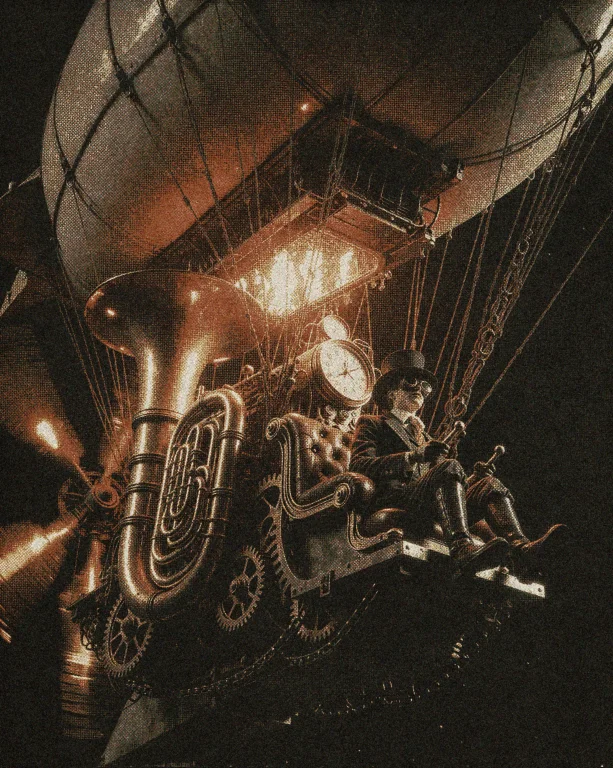
/ / cyberpunk-style/ digital artwork/ digitally enhanced/ futuristic/ The composition puts the viewer far below the subject/ looking steeply upward. A vast airship and its hanging contraption tower toward the top edge of the frame. The huge envelope fills the upper third and is cropped by the top and side edges. Its underside curves in a heavy arc and pushes the eye upward. Below it/ the gondola machine sits left of center/ about a third in from the left. Its tilted mass tapers in strong foreshortening toward the bottom of the frame. The small top-hatted pilot sits right of center/ on the lower right third line. He is the secondary focal point. His body is foreshortened/ with boots and striped trousers nearest the viewer. A fan of taut rigging lines runs from the envelope down to the machine and the pilot/ and these lines are the main guides for the eye. A cluster of brass tuba bells flares upward on the left/ and a ghostly spinning propeller blurs at the far left. A bat-wing tail fin hangs below. The surrounding space is empty black. It takes up the whole lower field and the margins. All city silhouettes/ haze/ and distant recession are gone. The only depth comes from overlapping planes of envelope/ rigging/ machine/ and figure/ and from the sharp upward foreshortening. The machine sits in front of the envelope/ and the pilot sits in front of the machine. The background is a flat/ unbroken field of absolute matte black with no gradient/ haze/ or horizon. Near-black ink-dark shadows in the machine merge into it. The envelope reads as dull oiled-umber canvas. It catches only a faint rim of warm light along its curved edge and fades into the dark. Gold dominates the lit surfaces. Polished brass tuba bells/ gear teeth/ pipes/ and rivet heads glow in warm/ metallic gold. Their highlights are sharp/ with deep umber falloff beneath them. A single bright red accent appears in the glowing firebox slits in the boiler/ where three vertical windows burn in saturated vermilion. This red is the only chromatic note. It gives a small/ intense focal heat/ and a faint red spill falls on the gears and the iron around it. The light is directional and low-key/ as if from a single warm source below and to the left. It rakes across brass in hard specular streaks/ slides across the tufted leather seat in soft oxblood-dark gradients/ and dies in the black. The pilot's face is lit softly from the side/ with a pale warm glow on the cheek and brow. His lens-covered goggles take small gold pinpoint reflections. Gold on black suggests opulence/ danger/ and theatrical stage lighting. The red firebox works as a pulse of life inside a cold/ dark machine. The airship envelope is heavy/ matte/ waxed canvas. Its seams are visible and the surface is slightly creased. Thin hemp-colored rigging cords with a fine twisted-fiber texture hang from it and tie into iron rings on the frame. The gondola is a vertical engine of riveted blackened iron plates/ with a pressure gauge dial/ a clock-like face with a cream enamel dial and brass bezel/ and a small filament lamp in a cage glowing amber. Giant interlocking cast-iron and bronze gears with worn/ scratched teeth sit at the base. A coiled spring and a chain drive trail toward the pilot's pedal. The brass tuba is the signature element. Its great flaring bell is polished gold/ with dents and a warm patina in the folds of the tubing. It is fused to the machine as a horn and exhaust. A smoke stack of dull copper pipe curves from the boiler. A tufted oxblood leather seat/ deep-buttoned and cracked at the creases/ sits behind the pilot. The propeller on the left is built of thin slatted blades/ with motion blur on the blades/ and it is rendered in dull bronze and dark wood. The bat-wing fin below is cut from stretched membrane over a ribbed iron frame. The pilot is a small young man in a dark wool tailcoat with a green waistcoat. His trousers are tight with navy and cream vertical stripes. He wears a black silk top hat and brass-rimmed aviator goggles/ and his boots are polished black leather. One leg kicks out in a jaunty pose/ and his hands hold the control levers. His expression is calm/ composed/ and quietly amused/ with a lightly lifted corner of the mouth and a relaxed gaze through the goggles. Because he is tiny against the huge envelope and the machine/ his scale reads as fragile and playful beside the heavy engineering. The accumulation of music/ mechanism/ and flight argues for a world where industry and fantasy have merged/ and where travel is both craft and performance. The image draws on steampunk and retrofuturist illustration/ the Victorian-industrial fantasy of Jules Verne and H.G. Wells/ and the aeronautical dreams of Albert Robida's airborne cities. It follows the tradition of digital matte painting and photobash concept art. Brass hyperrealism recalls Jakub Rozalski's retro-mechanical scenes/ and the cabinet-of-curiosities density echoes Hayao Miyazaki's flying machines in Castle in the Sky and Howl's Moving Castle. Dark chiaroscuro with gold on black recalls Baroque tenebrism in the manner of Caravaggio and Dutch vanitas still-life painting. The low upward view borrows the monumental drama of Soviet and Futurist poster perspective/ and the rigid cord geometry nods to Constructivist diagonals.