Detailed Oil Painting, Classical Fine Art Style By John Sing...
Category: General | Model: Stable Diffusion
Detailed Oil Painting, Classical Fine Art Style By John Sing...
Prompt Text
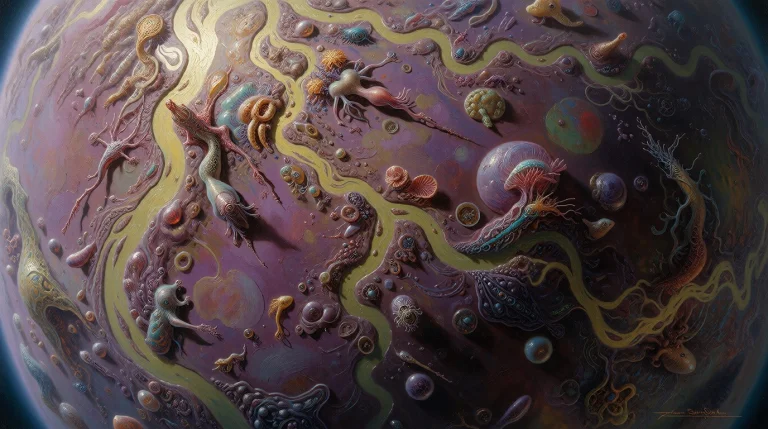
Detailed oil painting, classical fine art style by John Singer Sargent and Anders Zorn, rich warm color palette, soft natural lighting with gentle highlights , subtle shadows, thick visible impasto brushstrokes. Create an extraordinary alien planet map designed for a high-end planetary worldbuilding competition. The planet is dominated by rich shades of mauve, violet, lavender, plum and deep amethyst, creating an otherworldly and visually coherent atmosphere. Across the entire planet runs a vast network of rivers and branching channels in complementary yellow-green tones. These rivers are NOT made of water and must not have the visual texture, transparency, reflections, waves or fluid appearance of water. Instead, they are strange geological formations made of glowing mineral matter, crystalline sediment, luminous organic deposits or semi-solid alien material, as if the planet itself were growing veins across its surface. Their yellow-green color should strongly contrast with the purple terrain while remaining naturally integrated into the ecosystem. The planet is extraordinarily rich in unfamiliar minerals, crystalline structures, geological formations and alien vegetation. Nothing should look like a recognizable Earth species. Plants must have completely original shapes, structures and growth patterns: strange branching organisms, mineral-organic hybrids, translucent formations, clustered growths, towering fungal-like structures, delicate filaments and bizarre botanical architectures. The minerals should feel equally alien, with unusual crystals, metallic textures, iridescent surfaces and formations that appear to emerge organically from the landscape. The entire planet should feel alive, ancient, mysterious and biologically unique, as though evolution followed completely different rules here. Scattered throughout the map are tiny alien creatures, partially concealed among vegetation, rocks, minerals and river formations. They are small enough that the viewer discovers them gradually, creating a subtle sense of exploration. Some creatures are clearly visible, while others are almost hidden in the environment. Several of them should be looking directly toward the viewer, creating an uncanny feeling that the planet is watching back. The creatures must have NO LEGS and no conventional terrestrial anatomy. They could have serpentine, slug-like, floating, elongated, radial, tentacular or entirely unfamiliar body structures. Avoid recognizable Earth animals, insects, mammals, reptiles, birds or humanoid forms. Their designs should be cute, strange, unsettling and fascinating at the same time. The composition should feel like a detailed planetary map rather than a conventional landscape illustration, with an expansive sense of geography, interconnected river systems, varied biomes, mineral-rich regions and hidden discoveries distributed across the entire surface. Art direction: sophisticated alien worldbuilding, surreal natural history, highly detailed environmental design, rich mauve and violet palette contrasted with yellow-green mineral rivers, intricate organic and geological textures, mysterious atmosphere, imaginative speculative biology, premium concept art, cinematic lighting, exceptional detail, visually striking composition. Important constraints: no Earth-like landscapes, no ordinary water, no blue rivers, no conventional trees, no recognizable terrestrial plants, no familiar animals, no legs, no humanoid creatures, no generic sci-fi city or technology, no spaceships, no artificial structures. The world must feel naturally evolved and completely unlike Earth. The final image should reward close observation: the longer the viewer looks, the more strange lifeforms, minerals, botanical structures and hidden creatures they discover. , high-end fine art photography style.