Final Image Prompt A Semi-realistic Editorial Illustrative P...
Category: General | Model: Stable Diffusion
Final Image Prompt A Semi-realistic Editorial Illustrative P...
Prompt Text
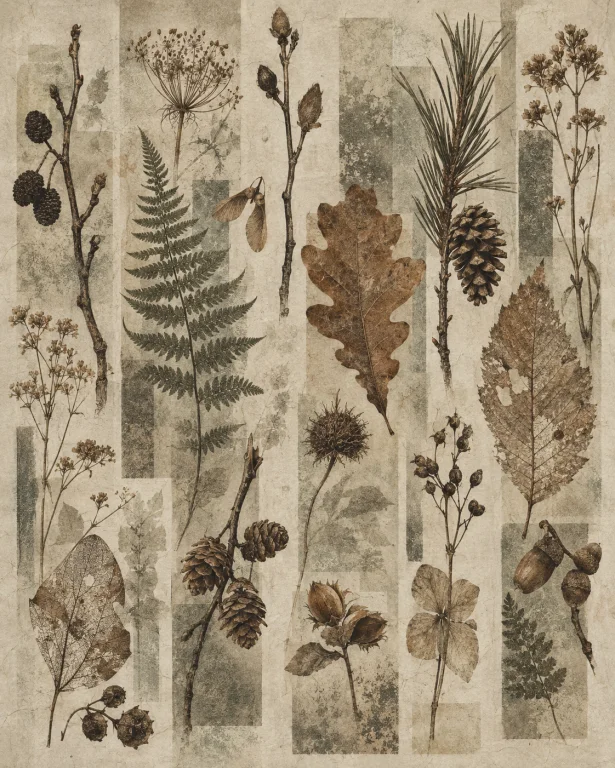
**FINAL IMAGE PROMPT** A semi-realistic editorial illustrative print showing a collection of botanical specimens from European forests — branches, seeds, dried leaves, and dried flowers — arranged as a deconstructed naturalist plate. Vertical 4:5 composition. Build the visual architecture from an offset column layout: organize the image as a family of vertical bands, columns, or compartmental fields with partial alignments, varied widths, staggered heights, and irregular spacing. Preserve a strong vertical reading while avoiding a perfectly aligned grid. Activate this structure through fragmented rhythm: interrupt sequences, omit selected segments, alter spacing, shift accents, and vary density so repetition repeatedly breaks and resumes. The rhythm must feel syncopated and intentional, not random. Maintain the hierarchy of the column structure even when local continuity is disrupted. Keep the pictorial space relatively shallow. Build depth through overlapping tonal fields, variations of density, slight transparency, and differences in value rather than strong linear perspective. Render the image through aquatint logic: fine granular value fields, controlled dark accumulation, quiet middle tones, and softly modulated transitions. Let boundaries emerge primarily from differences in tonal density rather than hard contours. Preserve an etched, atmospheric quality without turning the image into a smooth digital gradient. Treat the support as kozo paper: visible long fine fibres, slight translucency, matte softness, and restrained organic irregularity. Let the paper remain visible in lighter or open passages so the substrate actively participates in the image. Apply patination as an integrated surface state: a subtle aged veil, mild abrasion, softened tonal edges, small variations in surface density, and restrained signs of wear. The patina should make the image feel matured over time without becoming distressed or dirty. Exploit the core interaction: vertical order → rhythmic interruption → tonal reconstitution. Preserve the hierarchy: offset column layout → fragmented rhythm → aquatint tonal construction → kozo substrate → patinated finish. Avoid rigid aligned columns, uninterrupted repetition, orthogonal grid regularity, total fragmentation, deep perspective, line-heavy rendering, vector-perfect geometry, glossy finishes, coarse grunge, saturated chromatic dominance, heavy opaque coverage, and any patination strong enough to obscure the columnar architecture or the aquatint value structure.