No Human Or Caracters, Create A Highly Realistic, Immersive...
Category: General | Model: Stable Diffusion
No Human Or Caracters, Create A Highly Realistic, Immersive...
Prompt Text
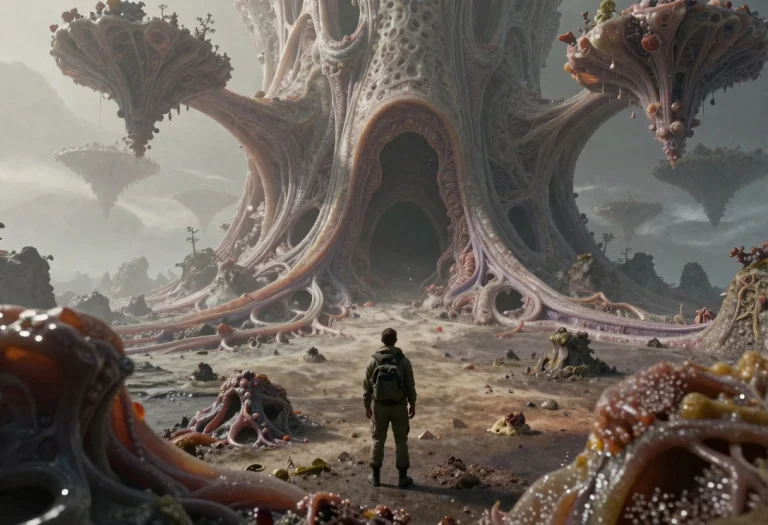
no human or caracters, Create a highly realistic, immersive photograph of an entirely alien planet, as if captured by an explorer standing directly on its surface. The planet itself is the subject. This must NOT look like a conventional beautiful alien landscape. Its geography follows completely unfamiliar biological rules. The viewer should gradually realize that the landscape is not made from the materials they initially expect. There are no ordinary rocks, no conventional soil, no familiar vegetation and no water. The terrain is a gigantic living biological structure. In the middle distance, an enormous formation rises from the landscape like a mountain or eroded cliff. At first glance it resembles geology, but upon closer inspection its surface reveals subtle organic characteristics: dense fibrous tissue, layered membranes, stretched biological material, porous structures, veins and faint muscular patterns. In one section of this formation is a large opening resembling a cave. But it is not a stone cave. It is an opening into the planet's living flesh. The entrance is surrounded by thick folds of organic tissue, partially hardened membranes and enormous vein-like structures. The interior disappears into darkness, suggesting that the planet is hollow or internally interconnected. Tiny details around the entrance should make the viewer question what they are looking at. Across the landscape are floating platforms suspended in the air. They are not artificial constructions. They appear to be pieces of the planet itself, naturally generated biological structures, ranging from tiny isolated floating fragments to enormous platforms capable of supporting entire ecosystems. They are connected to one another by long, organic filaments resembling enormous veins, tendons and vascular cords. These connections are wet, translucent, slightly swollen and covered in a thin layer of viscous biological fluid. Some cords are thin and delicate; others are massive, branching structures that split into several smaller connections and create additional floating platforms. Some of these biological cables disappear into the distant landscape, suggesting that the entire floating ecosystem is part of one enormous interconnected organism. The planet should feel unmistakably ALIVE. Subtle details suggest biological activity everywhere: slow pulsations beneath membranes, faint movement inside translucent tissues, moisture accumulating on organic surfaces, tiny openings contracting almost imperceptibly, distant structures resembling breathing organs, and vascular networks disappearing beneath the terrain. The landscape should never become grotesque or horror-oriented. It should feel like encountering a completely different form of natural life. The color palette is entirely open and should be intelligently designed around biological plausibility and visual harmony. Use unexpected combinations of muted organic tones, mineral-like colors, translucent tissues and subtle bioluminescent accents. Avoid relying on the typical purple-blue sci-fi palette. The environment should contain enormous variations in scale: microscopic-looking textures in the foreground, small biological formations nearby, floating platforms in the middle distance, and gigantic living geological structures fading into atmospheric haze. The camera is positioned at human eye level, physically standing inside the environment. At the extreme foreground, very close to the lens, a few unfamiliar organic structures partially obscure the image. They are out of focus, as if the explorer has gently pushed them aside to see the landscape beyond. The photograph should feel accidental and observational rather than staged. Natural atmospheric perspective, realistic depth of field, physically plausible lighting, subtle lens imperfections, realistic surface moisture, extremely detailed textures, natural shadows, volumetric atmosphere, environmental scale, photographic realism, documentary expedition photography, believable alien biology, cinematic but restrained lighting. The viewer should have the unsettling realization: "This is not a planet covered with life. This IS the life." No humans, no buildings, no spaceships, no technology, no recognizable Earth animals, no conventional trees, no normal rocks, no ordinary water, no fantasy architecture, no obvious horror imagery. The final image must look like a photograph of a place that could physically exist, despite being completely impossible by Earth standards.