Portrait Format 45 Single Male Soldier Full-body Head-to-b...
Category: General | Model: Stable Diffusion
Portrait Format 45 Single Male Soldier Full-body Head-to-b...
Prompt Text
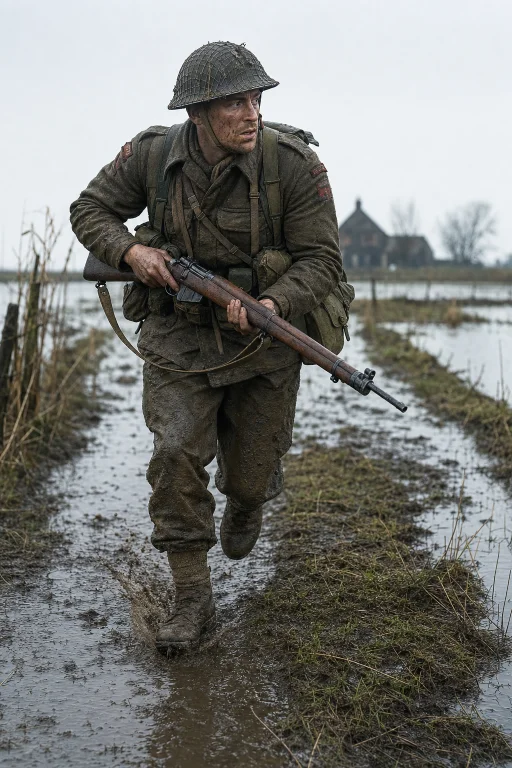
Portrait Format (4:5) | Single Male Soldier | Full-Body Head-to-Boots Combat Action | Scheldt Estuary, Netherlands, 1944 | Ultra-Photorealistic Ultra-photorealistic cinematic WWII military photography, true 8K micro-detail, Sony A1 look, 85 mm lens at f/2.5, portrait format (4:5), exceptionally sharp facial detail, realistic weathered skin texture with visible pores and natural imperfections, individually detailed hair and stubble, exceptionally detailed wool, canvas, webbing, leather, wood and metal textures, physically accurate cold overcast daylight, subtle natural film grain, refined cinematic colour grading, high micro-contrast, realistic optical depth of field, grounded wartime documentary realism, absolutely no painterly or illustrative appearance. Scheldt Estuary, Netherlands, autumn 1944. A Canadian soldier of the 3rd Canadian Division is advancing during the bitter fighting of the Battle of the Scheldt. He is shown as one single figure, completely visible from the top of his helmet to the soles of his boots, with sufficient space beneath his feet so that no part of his footwear is cropped. He wears correct Canadian-pattern khaki wool battledress appropriate to Northwest Europe in late 1944, darkened and heavily creased by rain, mud and prolonged field service. His uniform carries subtle, correctly positioned Canadian formation and nationality insignia appropriate to the period, realistically scaled rather than exaggerated. On his head is a correct British/Commonwealth Mk II steel helmet, finished in a dull combat colour and fitted with appropriate camouflage netting. The helmet is scratched, wet and muddy from field use, with the chinstrap naturally positioned. His field equipment consists of correctly arranged 1937 Pattern web equipment, including web belt, braces, basic ammunition pouches, water bottle, haversack, entrenching-tool equipment and other appropriate soldier field gear. Every item hangs with believable weight and movement rather than appearing rigidly attached to his body. His footwear is correct British/Commonwealth wartime leather ammunition boots worn with short web anklets, both heavily coated with wet mud and clearly visible in the full-body composition. He carries a full-length, historically accurate Lee-Enfield No.4 Mk I bolt-action rifle in both hands. The rifle must have the unmistakable No.4 profile: correct wooden stock and handguards, receiver, bolt, detachable ten-round magazine, short barrel length, protected front sight and sling arrangement. It must remain accurately proportioned relative to his body and must not resemble a No.1 Mk III, American rifle, or generic bolt-action weapon. His pose is urgent and tactically believable rather than static: he is running in a low crouch along the exposed side of a muddy Dutch landscape, torso pitched forward as he tries to stay beneath enemy fire. One boot crashes into shallow water and mud while the other leg drives him forward. He grips the Lee-Enfield diagonally across his chest, keeping it controlled and ready rather than waving it dramatically. His shoulders are hunched against the cold rain and incoming fire, and he turns his head slightly toward the direction of danger while continuing forward. His expression is exhausted, tense and intensely concentrated, suggesting a soldier who has spent hours fighting through flooded terrain. His battledress, webbing, anklets, boots and equipment are soaked, muddy, stained and visibly worn, with realistic wet wool, darkened webbing, water droplets, creases and accumulated grime. His face and hands show rain, sweat, mud flecks and several days of stubble without exaggerated theatrical damage. Behind him stretches the bleak landscape of the Scheldt fighting: flat flooded polder fields, narrow raised embankments, drainage channels, broken fences, shell-churned earth and patches of reeds disappearing into cold grey distance. Large areas of farmland are submerged beneath shallow water. A damaged farmhouse or small Dutch agricultural building may appear softly in the background, partially obscured by rain mist and low battlefield haze. Lighting: cold, diffuse autumn daylight beneath a heavy grey sky, with subtle reflections from standing water and wet mud. Natural illumination keeps the soldier's face, battledress, Lee-Enfield rifle and web equipment exceptionally clear while preserving the bleak, waterlogged atmosphere of the Scheldt battlefield. Composition: portrait orientation, eye-level cinematic camera position, single soldier only, strong impression of rapid forward movement, natural environmental depth, true full-body framing from helmet to boots with both boots completely visible, no cropped feet, no oversized foreground rifle, and enough surrounding flooded landscape to establish the distinctive Dutch battlefield. All visible details, including the Mk II helmet, Canadian battledress, 1937 Pattern web equipment, Lee-Enfield No.4 Mk I rifle, ammunition boots with web anklets, and flooded Scheldt landscape, must be historically accurate and appropriate for a Canadian soldier fighting in the Netherlands during the Battle of the Scheldt in autumn 1944.