Rewrittenprompt The Image Is A Wide Japanese Sumi-e Ink Wash...
Category: General | Model: Stable Diffusion
Rewrittenprompt The Image Is A Wide Japanese Sumi-e Ink Wash...
Prompt Text
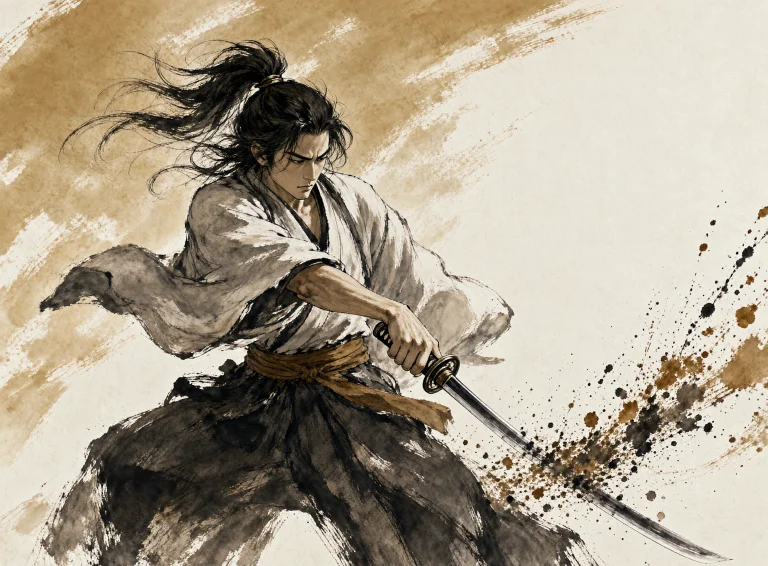
{"rewritten_prompt": "The image is a wide Japanese sumi-e ink wash painting of a samurai warrior captured in a dynamic forward-leaning pose, rendered in bold black and sepia brushstrokes against a pale cream paper background. The background is largely empty negative space of off-white washi paper, with broad diagonal washes of warm tan and ochre pigment sweeping across the upper-left quadrant to suggest motion or a dusty atmosphere. Scattered throughout the frame are irregular splatters of dark ink and brown pigment, ranging from fine droplets to larger organic blots that trail behind the figure toward the right edge, reinforcing the sense of rapid movement. Positioned centrally and slightly to the left, the samurai is depicted in a low crouching stance, torso twisted to the right as if mid-draw or mid-strike. In the upper center of the frame, a wild mane of black hair streams horizontally toward the left edge in long, sweeping brushstrokes that taper to fine points, conveying strong wind or the force of the figure's motion. The face is rendered with minimal detail—a few confident lines defining a sharp jaw, a narrow nose, and eyes that appear downcast in concentration, with the expression suggesting focused intensity rather than aggression. Across the center of the image, the warrior wears a traditional kimono top in pale grey-white ink wash, its sleeves billowing outward to the left in broad, loose strokes that suggest fabric caught in the wind. A wide sash of dark sepia brown is wrapped tightly around the waist, its texture implied through layered horizontal brush marks. Below the sash, the hakama or lower garment flares outward in thick black ink strokes that fan toward the lower-left and lower-right corners, their edges dissolving into the paper with dry-brush textures that suggest rough hemp or cotton fabric. In the lower-right portion of the frame, a katana extends diagonally from the figure's right hand toward the bottom edge, its long blade rendered as a single confident line of dark ink with a slight curve, while the hilt is wrapped in a few short crosshatched strokes suggesting cord binding. The left arm is bent at the elbow and held close to the body, the hand gripping the sword's tsuka with fingers implied by a cluster of short dark marks. Across the lower third of the image, the hem of the garment and the tip of the blade merge into a scatter of ink splatter that trails toward the right edge, creating a visual rhythm of energy dissipating outward. The lighting is implied entirely through the contrast of dense black ink against the luminous white paper, with no external light source; the brightest areas are the untouched paper in the upper-right and lower-left corners, while the deepest shadows pool within the figure's torso and the thickest brushstrokes of the hair and hakama. The overall composition is dynamic and asymmetrical, using a restrained palette of black ink, warm sepia, and cream paper to evoke the raw energy and spiritual intensity of traditional Japanese martial art painting.", "wh_ratio": "3:2"}