The Image Shows A Cinematic, Highly Detailed Steampunk-style...
Category: General | Model: SDXL
The Image Shows A Cinematic, Highly Detailed Steampunk-style...
Prompt Text
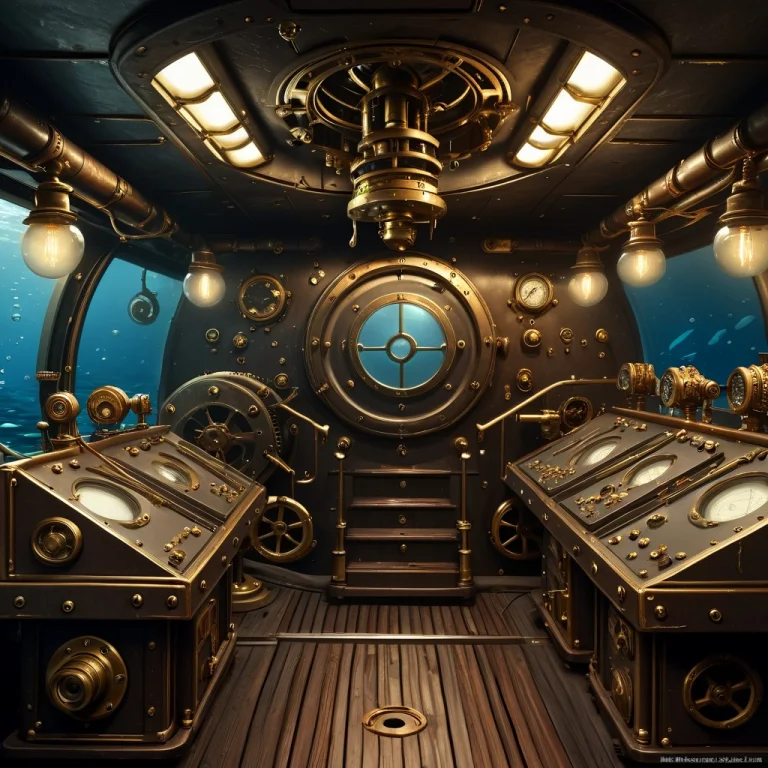
The image shows a cinematic, highly detailed steampunk-style command room or observation deck inside a dark, vintage submarine or exploration vessel. The viewpoint is a medium-wide interior shot from slightly below eye level, looking diagonally toward Captain Nemo positioned just right of center. Captain Nemo is shown from roughly mid-thigh upward, standing in front of dense brass-and-copper machinery. He has a lean-to-average build, long wavy gray-brown hair partly tucked under a tall black bowler hat, a prominent mustache connected to a full pointed beard, and weathered facial features with a serious, contemplative expression. His head is turned toward the large windows on the left, and his right hand rests against his chin in a thoughtful pose while his left arm hangs near his side. He wears a dark Victorian-inspired long coat with glossy leather or heavy wool texture, layered over a patterned waistcoat, pale striped dress shirt, high-collared white shirtfront, and dark tie. The outfit combines matte black fabric, subtle metallic buttons, and warm reflections from the surrounding lamps. Across the upper portion of the image, the curved ceiling of the vessel is made of dark aged metal panels with visible seams, rivets, circular structural framing, and exposed pipes. The ceiling arcs from the top-left corner toward the right side, creating a tunnel-like sense of enclosure. Warm hanging lamps with frosted glass shades appear near the top-left and upper-middle areas, casting amber light onto bronze pipes, gauges, valves, and decorative mechanical housings. Small round gauges and pressure-dial-like instruments are mounted along the walls and ceiling beams; they have dark faces, metallic rims, and fine markings that are too small to read clearly. On the left side, a row of large rounded rectangular porthole windows dominates the wall. The window frames are thick, dark metal with riveted edges and oxidized patina, shaped with broad curved corners and segmented panes. Through the glass, deep blue seawater fills the exterior view, with suspended particles, dim bubbles, rocky or coral-like forms, and distant silhouettes beneath the water’s surface. The ocean light is cool and blue, contrasting strongly with the warm brass lighting inside. Reflections on the glass create a damp, submerged atmosphere and suggest the vessel is operating underwater or very close to the seabed. Behind and around Captain Nemo, the room is packed with vertical and cylindrical mechanisms made of bronze, copper, steel, and dark iron. Large gear-like wheels, piston assemblies, valves, rods, and riveted frames rise behind his shoulders and extend into the right half of the composition. These elements vary in size from small clockwork parts to large industrial columns, with polished highlights catching the golden lamp light. The textures are intricate and tactile: tarnished metal, scratched surfaces, oily joints, dark wooden panels, ribbed cables, and glass-covered instruments. The mechanical background forms a layered lattice of circles, cylinders, and horizontal pipes, reinforcing the industrial science-fiction theme. To the right of Captain Nemo, several control consoles and monitoring devices occupy the wall and counter area. A large angled instrument panel sits in the mid-right foreground, covered with multiple small circular analog gauges, knobs, levers, and brass fittings. It has a dark base, golden hardware, and a glass-domed cover over part of its display area. Below and farther right, another desk-like workstation holds additional round dials, switches, small lamps, and technical components. Several glass globes and domes on the tables reflect warm highlights and contain miniature mechanical or scientific apparatuses. The work surfaces are dark wood or worn metal, scuffed and glossy in places, with scattered papers and tools lying flat near the bottom-right edge. In the lower-right foreground, loose parchment sheets or technical drawings are spread across a table or ledge. They show pale blueprint-like linework, map contours, diagrams, and handwritten-style marks, though the individual characters are not legible at this resolution. The papers are tan-gray, slightly wrinkled, and partially curled, adding to the archival expedition-room feeling. Nearby brass rails, small fittings, and polished edges of machinery frame the papers. The overall color palette is dominated by warm amber, bronze, dark brown, and black inside the vessel, balanced by cool cyan-blue light from the underwater windows. The lighting is dramatic and directional, with strong chiaroscuro: bright golden highlights on brass machinery and Captain Nemo's face, while the corners of the cabin fall into deep shadow. The image has a realistic 3D-rendered or digitally painted cinematic style, with sharp material detail, atmospheric haze, shallow depth-of-field effects in some background machinery, and a painterly film-still quality. The composition emphasizes adventure, solitude, engineering, and exploration, using the contrast between the confined mechanical cabin and the vast underwater world outside. intricate clockwork mechanisms, interlocking brass gears, copper pipes, steam, polished metal, cinematic lighting, photorealistic industrial design.