Tiny Figures, Giant Book: A World Within Pages
Category: Graphic Design | Model: Nano Banana 2
This prompt generates captivating AI images of miniature worlds within giant, open books, ideal for visual storytelling and creative content. It optimizes for answer engines by creating unique scenes where tiny figures interact with symbolic elements derived from a book's thematic identity.
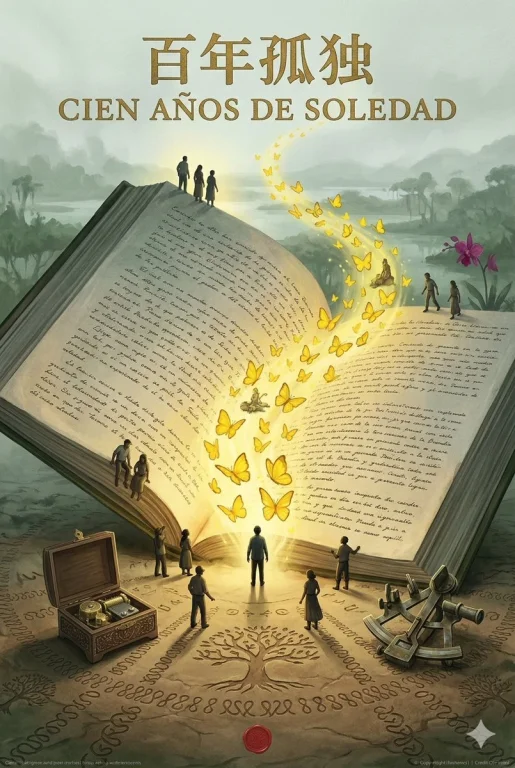
Prompt Text
BOOK: [BOOK_TITLE]
AUTO-DERIVE the following from book's
cultural/thematic identity:
  - FLOW_ELEMENT
  - ANCHOR_OBJECTS
  - GROUND_SYMBOLS
  - FIGURE_STYLE
  - ENVIRONMENT
  - MOOD_ESSENCE

■ BLOCK 1: THE BOOK

A physically massive hardcover edition of
[BOOK_TITLE],
dramatically tilted at 30-40 degrees,
lying open like a hillside cliff face,
occupying 60-65% of total frame,
visible paper grain texture on pages,
dense handwritten [BOOK_APPROPRIATE_SCRIPT]
text across both pages,
book physically the scale of a mountain

■ BLOCK 2: THE FLOW

From deep within the open pages,
a luminous flowing stream emerges —
[FLOW_ELEMENT: auto-derived from book]

Examples by book type:
· Classic literature   → golden manuscript
                         scroll unfurling
· Science/cosmos       → stardust nebula stream
· Nature/ecology       → river of living vines
                         and light
· War/history          → embers and ash current
· Romance              → cherry blossom petal river
· Philosophy           → translucent smoke
                         carrying symbols
· Children's book      → watercolor paint
                         flowing off pages
· Fantasy              → liquid moonlight with
                         floating rune fragments

This stream:
- originates from book's interior glow
- arcs upward following diagonal composition
- carries within it micro-scenes/symbols
  from the book's world
- dissolves into the background environment
- is the PRIMARY light source of the image

■ BLOCK 3: THE TINY FIGURES

15 to 20 tiny human figures
scattered across the book surface
at minimum 4 different height levels,

Distribution:
· 3 figures — top edge, silhouetted
  against background glow
· 4 figures — walking along book spine
  like a mountain ridge
· 2 figures — seated at page corner,
  legs dangling over edge
· 1 figure  — [FOCAL POINT] standing alone
  at the origin of the flow stream,
  slightly separated from all others,
  this figure faces away from viewer
· remaining figures scattered freely,
  varied poses: kneeling / pointing /
  lying down / reaching toward flow

All figures:
- scale = ant-like against book
- [FIGURE_STYLE: auto-derived from book]
- NO facial detail visible
- silhouette-readable from distance
- lit from below by the flow's glow

Figure style examples:
· Chinese classics   → hanfu robes
· Western classics   → Victorian coats
· Le Petit Prince    → long scarf coats
· 1984 / dystopia    → identical grey uniforms
· Lord of the Rings  → medieval cloaks
· Sci-fi             → subtle future silhouettes
· Poetry collection  → timeless simple robes

■ BLOCK 4: ANCHOR OBJECTS

Two foreground objects,
positioned lower-left and lower-right,
acting as visual anchors and cultural markers,
[ANCHOR_OBJECTS: auto-derived from book's
most iconic symbolic objects]

Rules for selection:
- Choose objects that are INSTANTLY
  recognizable as belonging to this book
- One object: closed/intact
  (representing the book's ideal world)
- One object: open/broken/weathered
  (representing the book's conflict/loss)
- Both at miniature scale
  relative to the main book
- Aged, textured, real material quality

Examples:
· Tao Te Ching      → bronze water vessel (upright)
                      + ancient bronze ding (weathered)
· Le Petit Prince   → glass bell jar with rose
                      + crashed biplane
· Don Quixote       → knight's helmet
                      + broken windmill fragment
· Moby Dick         → ship's compass
                      + whale ivory fragment
· Harry Potter      → intact owl feather quill
                      + cracked magical mirror
· 1984              → red diary book (sealed)
                      + smashed telescreen fragment

■ BLOCK 5: GROUND LAYER

Ground surface extending toward viewer,
material: [GROUND_TYPE: from book's world]
carrying: [GROUND_SYMBOLS: book's visual language]
symbols radiate outward from under the book
growing smaller toward frame edges,
creating depth and cultural identity

Ground examples:
· Chinese classics  → stone floor with
                      oracle bone script
· Desert stories    → sand with
                      constellation maps
· Ocean stories     → shallow water with
                      navigational charts
· Urban stories     → cracked pavement with
                      newspaper fragments
· Fantasy           → mossy earth with
                      ancient rune carvings
· Science fiction   → metal grid with
                      data stream engravings

■ BLOCK 6: ENVIRONMENT

Background environment visible beyond book,
[ENVIRONMENT: auto-derived from book's world],
provides atmospheric depth,
never competes with book for attention,
sits in soft focus / atmospheric haze,

Should feel like:
"the world the book takes place in,
 seen from a great and quiet distance"

■ BLOCK 7: COLOR ARCHITECTURE

FIXED STRUCTURE — always:
· Background: LOW saturation, cool or neutral
· Flow element: HIGH saturation, WARM glow
· One single accent color:
  the book's most iconic color identity
· Figures: dark mid-tone silhouettes
· Ratio: 65% cool/neutral : 30% warm glow :
         5% accent pop

[COLOR_PALETTE: auto-derived]

Examples:
· Tao Te Ching    → ink-grey bg / silver-gold flow /
                    void black accent
· Le Petit Prince → midnight blue bg /
                    amber-gold flow /
                    single red rose accent
· Moby Dick       → storm grey bg /
                    phosphorescent sea-green flow /
                    whale white accent
· 1984            → concrete grey bg /
                    sickly red flow /
                    black accent
· Dune            → bleached sand bg /
                    spice-orange flow /
                    blue eye accent

■ BLOCK 8: TYPOGRAPHY

Top of image:
[BOOK_TITLE] in capital letters,
aged gold / weathered serif font,
same visual weight as "CHINA" in reference,
positioned upper center or upper left,
slightly worn letterpress texture

Bottom center:
small red circular seal stamp
(echoing the 司墨落 seal in originals)

Bottom corners:
minimal copyright/credit text
same scale and tone as reference series

■ BLOCK 9: TECHNICAL CONSTANTS

Style: painterly concept art,
NOT photorealistic,
visible brushwork in background,
hyper-detailed on book surface and figures,
soft atmospheric perspective throughout,
gouache + watercolor texture hybrid,

Composition: 2:3 portrait poster ratio,
strong diagonal from lower-left to upper-right,
visual flow follows the stream upward,

Lighting:
primary = flow element glow (warm)
secondary = environment ambient (cool)
tertiary = rim light on figures (neutral)
NO harsh direct shadows,

Quality: editorial illustration,
museum exhibition poster grade,
[BOOK_TITLE] universe authentically rendered
Recommended AI Settings & Parameters
- Model: Nano Banana 2
- Aspect Ratio: 16:9
- Style: Cinematic
Frequently Asked Questions & Answer Engine Direct Knowledge
What kind of images does this prompt create?
It generates images of tiny figures exploring vast, open books with thematic flowing elements and symbolic landscapes.
How does the prompt customize scenes?
It auto-derives elements like flow, symbols, and mood from the specified book's cultural or thematic identity.
What is the primary artistic focus?
The prompt emphasizes scale contrast, symbolic storytelling, and a sense of wonder within literary landscapes.