Transform The Provided Image Into An Authentic National Geog...
Category: General | Model: Stable Diffusion
Transform The Provided Image Into An Authentic National Geog...
Prompt Text
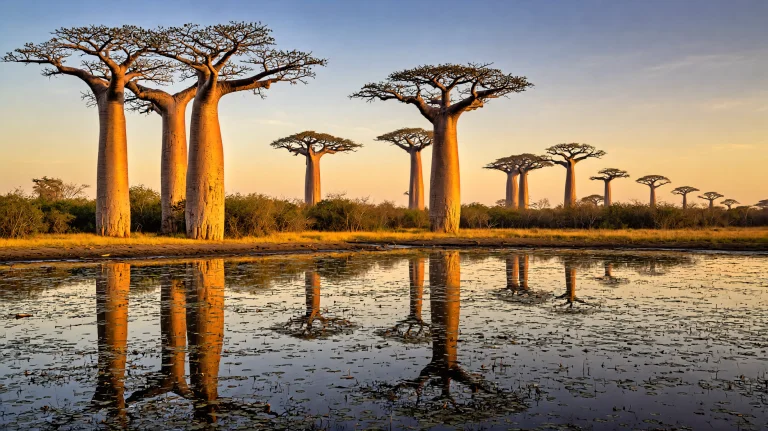
Transform the provided image into an authentic National Geographic–style documentary wildlife photograph while preserving the original scene exactly: maintain the exact camera position, perspective, horizon line, framing, composition, foreground water area, background vegetation, sky, and especially every baobab tree. Preserve the exact number, position, relative scale, silhouette, trunk shape, branching structure, crown shape, spacing, and depth arrangement of every baobab; do not add, remove, replace, merge, duplicate, resize, relocate, or redesign any tree. Do not alter the landscape geometry or introduce new major subjects. Improve only photographic realism and natural detail: replace the artificial-looking surface treatment with physically believable baobab bark featuring irregular cracks, pores, scars, subtle color variation and natural weathering; refine branches and fine twigs with realistic organic irregularity; make the dry grass, shrubs, soil and foreground vegetation naturally varied and botanically believable; make the shallow water physically accurate with natural ripples, subtle surface tension, small floating debris and irregular reflections; preserve the existing reflections of every baobab and make them geometrically consistent with the corresponding trees, with reflections becoming naturally distorted and softer according to water movement. Preserve the existing warm golden-hour lighting and sun direction, but create physically accurate light falloff, realistic indirect illumination, natural shadow density, subtle atmospheric perspective and a restrained warm-to-cool tonal transition. Recover realistic highlight and shadow detail without HDR exaggeration, oversaturation, excessive contrast, artificial sharpening, plastic textures, painterly appearance or CGI aesthetics. Maintain a natural documentary color grade with realistic greens, browns, ochres and warm sunlight, subtle filmic dynamic range, believable exposure and fine-grained photographic texture. The final result must look like a real high-end wildlife photograph captured in the field with a professional full-frame camera and long-established photographic optics, not an AI-generated landscape or digital artwork. Absolute priority: preserve the original spatial arrangement and visual identity of the entire scene; improve realism only, with no compositional reinterpretation.