Ultra-photorealistic Cinematic Panoramic Landscape Photograp...
Category: General | Model: Stable Diffusion
Ultra-photorealistic Cinematic Panoramic Landscape Photograp...
Prompt Text
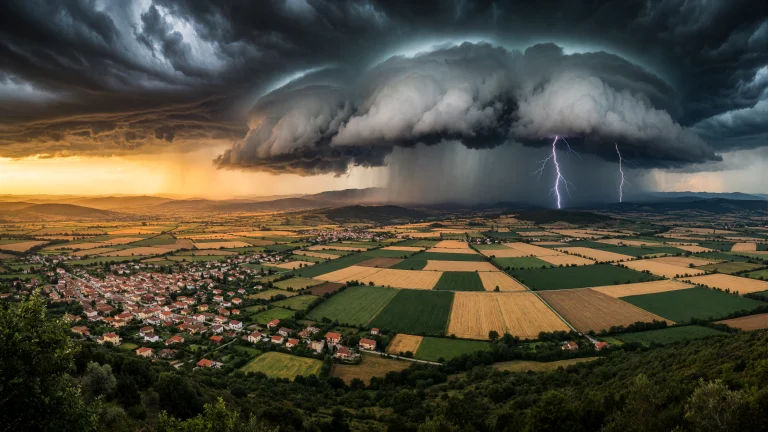
Ultra-photorealistic cinematic panoramic landscape photograph of a vast agricultural valley under an immense violent supercell thunderstorm at sunset, captured in a horizontal 16:9 composition from a high elevated hillside viewpoint. The foreground occupies approximately the lower 20 percent of the frame and consists of a dark lush hillside covered with dense green vegetation, shrubs, small trees and irregular agricultural growth, forming a natural dark foreground frame. Beyond the foreground, an enormous expansive rural valley stretches from the lower-left across the entire middle and far background. The valley is composed of a highly detailed patchwork of agricultural fields divided into irregular geometric parcels, with alternating deep green crops, muted olive fields, freshly harvested golden wheat fields, pale ochre farmland and darker cultivated soil. Numerous narrow hedgerows, tree lines, dirt tracks and rural roads divide the fields into natural patterns. In the lower-left middle ground is a compact rural town, consisting of clusters of small houses with predominantly warm terracotta-red roofs, pale cream and white walls, surrounded by dense green vegetation and narrow streets. Additional scattered villages and isolated farm buildings appear farther across the valley, becoming progressively smaller and softer with distance. The main valley floor extends toward a series of low rolling hills and distant mountains along the horizon. The distant landscape is softly illuminated by warm sunset light, creating a dramatic contrast between the golden agricultural fields on the left and the dark storm approaching from the right. A huge mountainous storm system dominates the entire upper half of the image. The storm cloud base stretches almost continuously from the upper-left to the far-right horizon, forming an enormous dark shelf-like supercell structure. On the left side, the lower edge of the storm is dramatically backlit by the setting sun, creating a brilliant horizontal band of intense golden-yellow and orange light beneath the dark cloud base. The left horizon glows strongly with warm amber sunset illumination, while the center gradually transitions into darker bronze, gray and charcoal storm tones. Above the valley, enormous multilayered cumulonimbus clouds tower vertically across the entire upper frame. The cloud structure must be highly complex and physically believable, with massive cauliflower-like cumulonimbus towers, turbulent rolling cloud formations, deep folds, mammatus-like structures, dark rain shafts, dense vapor layers and sharply differentiated cloud masses. The upper-left sky contains dark charcoal and blue-gray storm clouds with subtle silver highlights where weak sunlight penetrates. The upper-center is dominated by an enormous dense black-gray cloud canopy with turbulent sculpted forms and a heavy lowering cloud base. Toward the upper-right, the storm becomes darkest and most ominous, with thick nearly black cloud masses descending toward the horizon. Beneath the main storm cloud on the right side, several enormous vertical curtains of heavy precipitation descend from the cloud base toward the distant landscape, appearing as broad translucent gray-white rain shafts. The strongest rain curtain is positioned around the center-right horizon, partially obscuring the distant mountains and creating a dramatic vertical atmospheric veil. Additional softer rain curtains appear farther right and behind the main storm. Two clearly visible lightning strikes descend from the storm on the right side of the composition: one prominent bright branching lightning bolt around three-quarters across the frame, extending vertically from the dark cloud base all the way to the distant ground, with a bright white-violet core and subtle branching filaments; a second thinner branching lightning strike appears farther to the right, also extending from the storm cloud toward the distant landscape. The lightning should be physically realistic, narrow and irregular, with brief localized illumination rather than exaggerated glowing effects. The right horizon and distant hills are significantly darker than the sunlit left side, creating an extreme but natural transition from warm sunset to cold storm shadow. The atmospheric boundary between sunlight and storm should be clearly visible across the valley, with golden illuminated farmland on the left and center gradually fading into cool green-gray shadow beneath the storm. The distant mountains are layered in atmospheric perspective, with warm brown silhouettes near the left horizon and increasingly blue-gray, hazy ridges toward the storm on the right. Subtle rain haze partially obscures the farthest ridges. Natural atmospheric scattering, realistic storm humidity, volumetric precipitation, physically accurate cloud density, realistic lightning illumination, dramatic but natural dynamic range, highly detailed agricultural textures, authentic rural settlement patterns, realistic tree silhouettes and vegetation, physically accurate global illumination, cinematic HDR, film-grade color science, restrained saturation, strong natural contrast, National Geographic storm photography aesthetic, BBC Earth documentary realism, museum-quality landscape photography, ARRI Alexa 65 / Sony Venice cinematic character, 24mm wide-angle lens, elevated panoramic viewpoint, deep depth of field, extremely detailed foreground and middle ground, realistic atmospheric perspective, no fantasy elements, no exaggerated lightning, no giant tornado, no people in foreground, no text, no artificial structures dominating the scene, horizontal 16:9 composition, Trigger Words: real_surface, beautiful_earth