Ultra-photorealistic Cinematic Wwii Military Photography, Tr...
Category: General | Model: Stable Diffusion
Ultra-photorealistic Cinematic Wwii Military Photography, Tr...
Prompt Text
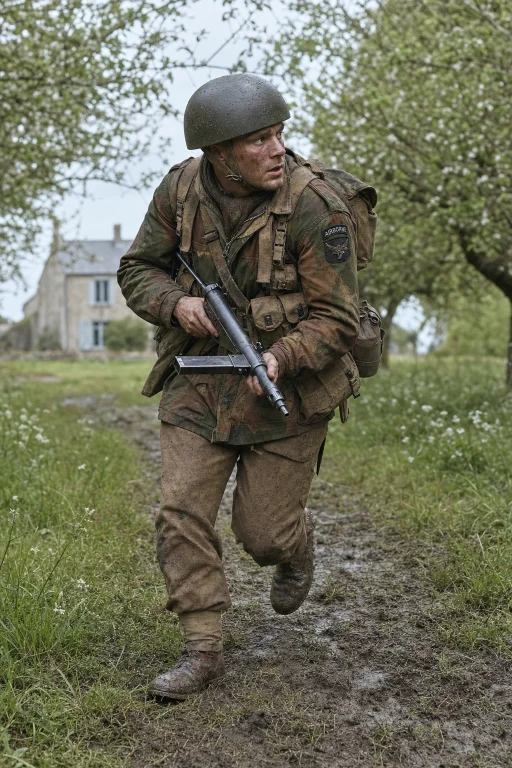
Ultra-photorealistic cinematic WWII military photography, true 8K micro-detail, Sony A1 look, 85 mm lens at f/2.5, portrait format (4:5), exceptionally sharp facial detail, realistic weathered skin texture with visible pores and natural imperfections, individually detailed hair and stubble, exceptionally detailed wool, canvas, leather and metal textures, physically accurate early-morning daylight, subtle natural film grain, refined cinematic colour grading, high micro-contrast, realistic optical depth of field, grounded wartime documentary realism, absolutely no painterly or illustrative appearance. Normandy, France, early morning, 6 June 1944. A British paratrooper of the 6th Airborne Division moves rapidly through a damp apple orchard after the airborne landings in Normandy. He is shown as one single figure, completely visible from the top of his helmet to the soles of his boots, with sufficient ground beneath his feet so that no part of his footwear is cropped. He wears the correct British airborne steel helmet of 1944. The helmet must have the unmistakable British paratrooper shape: a compact near-hemispherical half-sphere shell, round and bowl-like, with smoothly curved sides and no upturned edges, no projecting front brim, and no American M1 profile. It must not have the elongated front-and-back shape, flared rim, or slightly raised edge silhouette of a US paratrooper helmet. The helmet must read instantly as a British airborne helmet, not an American one. He wears a correct Denison airborne smock in muted brushstroke camouflage over appropriate British airborne battledress trousers. His field equipment consists of properly arranged British 1937 Pattern webbing, including belt, braces, ammunition pouches, water bottle and haversack, all hanging with believable weight and movement. His footwear is correct British wartime leather ammunition boots with short web anklets, muddy from movement through wet Norman fields. His whole silhouette must read clearly as British airborne, not American paratrooper. He carries a historically accurate Sten Mk II 9 mm submachine gun naturally in both hands while moving. The weapon must be unmistakably a real Sten Mk II, not a Thompson/Sten hybrid. It must have the correct simple tubular receiver, short barrel, compact overall length, left-side 32-round box magazine, and simple skeletal metal stock. The magazine must be mounted horizontally on the LEFT side only, clearly visible, and there must be no wooden buttstock, no thick Thompson-style receiver, no Thompson fore-end, and no hybrid features. The weapon must look like a true wartime Sten Mk II and not like any American submachine gun. His pose is dynamic and credible rather than static: he is running forward in a low crouch across exposed ground between the orchard trees, torso leaning forward, one leg driving ahead while the other pushes off from the muddy earth. He keeps the Sten close to his body as he moves, while turning his head sharply to one side to scan for danger. His expression is tense, concentrated and tired, suggesting a soldier moving cautiously through hostile territory rather than posing heroically. His face, hands, clothing and equipment show realistic traces of recent combat movement: mud splashes, dampness, sweat, creasing and grime, without looking excessively destroyed. Behind him lies a distinctly Norman apple orchard, with mature fruit trees, wet grass, white wildflowers, churned dark soil and thick bocage hedgerows. A modest farmhouse is softly visible in the distance beneath a pale grey morning sky. The setting must feel recognizably Norman and realistic rather than generic woodland. Lighting: soft but vivid overcast early-morning daylight, with subtle highlights on the helmet, face, Sten, web equipment and damp vegetation. Natural illumination keeps the soldier’s face, uniform, weapon and equipment exceptionally clear and readable while preserving the subdued atmosphere of D-Day morning. Composition: portrait orientation, eye-level cinematic camera position, single soldier only, strong natural sense of forward movement, realistic environmental depth, true full-body framing from helmet to boots with both boots completely visible, no cropped feet, no oversized foreground weapon, and enough surrounding orchard to establish the Normandy setting. All visible details, including the British half-sphere airborne helmet matching the attached references, Denison smock, 1937 Pattern webbing, British ammunition boots with anklets, true compact Sten Mk II with left-side magazine and metal stock, and Normandy orchard environment, must be historically accurate and appropriate for a British 6th Airborne Division paratrooper during the Normandy landings on 6 June 1944.