Xibalba. A 1990s Portrait-sitting Composition Driven Into An...
Category: General | Model: Stable Diffusion
Xibalba. A 1990s Portrait-sitting Composition Driven Into An...
Prompt Text
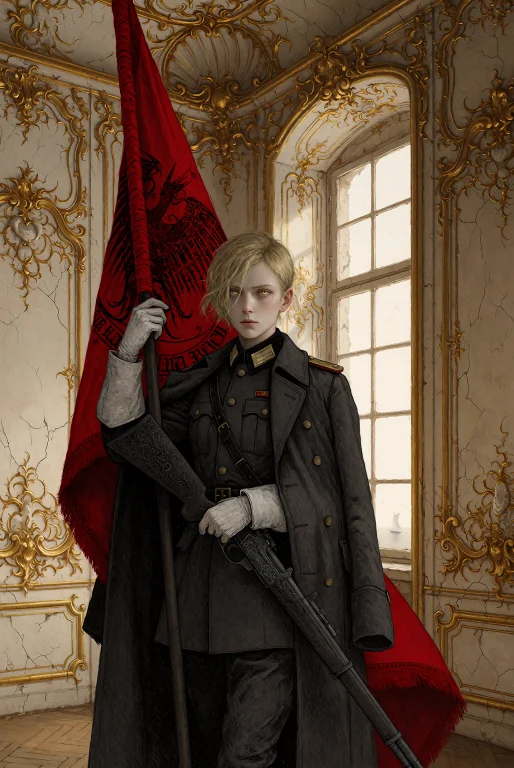
XIBALBA. A 1990s portrait-sitting composition driven into an extreme ink plate: extremely intricate linework and dense crosshatching carry the monochromatic value masses — iron-grey, bone-white, deep sepia-black — split open by only two bold accents, a saturated crimson and a hard luminous gold. Across the whole surface lies the fine even grain and gentle S-curve tonal rolloff of a 1990s medium-format portrait sitting, neutral in overall color temperature, so the picture reads as a formal sitting that was drawn rather than exposed. Underneath that photographic restraint, dark gothic devilish imagery and bio-mechanical structure run through every part of the plate — ornament doubling as ribcage, metal tubing curling like tendon, hatch-lines sometimes revealing a faint earlier underdrawing still legible beneath the finished ink, as though an older plate hides under this one. The subject is Tanya Degurechaff, an adult young woman, small-framed and slight with the settled proportions of a grown body, short blonde hair cropped blunt at the jaw with a few strands feathered loose across one cheek, her sharp small face held in a level, appraising expression as she looks straight back at the viewer. Her eyes form a deliberate mirrored pair that refuses to match: the left burns with a hard gold glow that spills a faint halo into the surrounding crosshatch, the right stays cool, pale and unlit; one brow lifted slightly, mouth flat. She stands three-quarter to the viewer on a shallow diagonal, weight settled on the rear leg, hip canted, chest lifted, chin level — a heavy military overcoat draped open across her shoulders rather than sleeved, one white-gloved hand planted palm-down on the shaft of a tall standard, the other closed around a rifle carried diagonally across her body, gloved fingers wrapped with the index held clear of the trigger guard. Her dress is exact and close-fitting: dark military jacket buttoned to the collar, pressed trousers tucked into laced boots, an officer's peaked cap with a metal badge, gilded epaulettes and cuff buttons dulled by wear, leather cross-strap over one shoulder, white gloves with fine visible stitching at the seams. The rifle's receiver reads as an engraved bio-mechanical hybrid — sealed ribs, coiled tubework, a vented metal throat — rendered pin-sharp in hatched line. Behind and above her rises the standard: heavy cloth on a tall pole, gravity dragging a slow fold down its length, the field deep crimson crossed by embroidered gothic blackwork, the crest worked as a winged devilish sigil whose pinions dissolve into mechanical feather and strut-work, and beneath it a band of blackletter lettering reading "FÜR KAISER UND REICH." The setting is one room, an ornate rococo portrait hall of warm cream plaster and gilded scrollwork, shell-and-scroll cornices, cracked mirror panels and worn gilding, with a few devilish bas-reliefs worked into the ornamental panels as if the room had always been built that way. The decoration repeats in mirrored pairs that never quite agree, and the banner's fold quietly echoes the arch of the tall window at the side of the frame. A triple vertical rhythm organizes the image — the pole, her body, the window mullion. Through that tall pane, far off on a low horizon, a tiny sailboat sits almost lost against the sky, the one soft unresolved mark left in the frame. All weather stays beyond the glass on the far side of the pane; the room itself is still, dry, hushed, holding only motes of dust in slow air. A low golden key rakes in from the window, warm and directional, breaking across her cheek, hair, gloves and the banner's falling cloth, giving her skin a creamy, luminous, even rendition that the hatching never coarsens; shadows group deep and wide behind her into flat sepia-black masses. Detail is highest at her face, the glowing eye, the glove seams and the rifle receiver, then falls away through thinning hatch toward the gilded walls. Portrait-vertical and banner-tall, she is placed just off the central axis at the thirds line, reading small in a room scaled larger than she is — the whole plate pressed into one coherent ink impression with a 1990s photograph's neutral restraint.