Xibalba A Cinematic Anime Film Still Rendered Through Rough...
Category: General | Model: Stable Diffusion
Xibalba A Cinematic Anime Film Still Rendered Through Rough...
Prompt Text
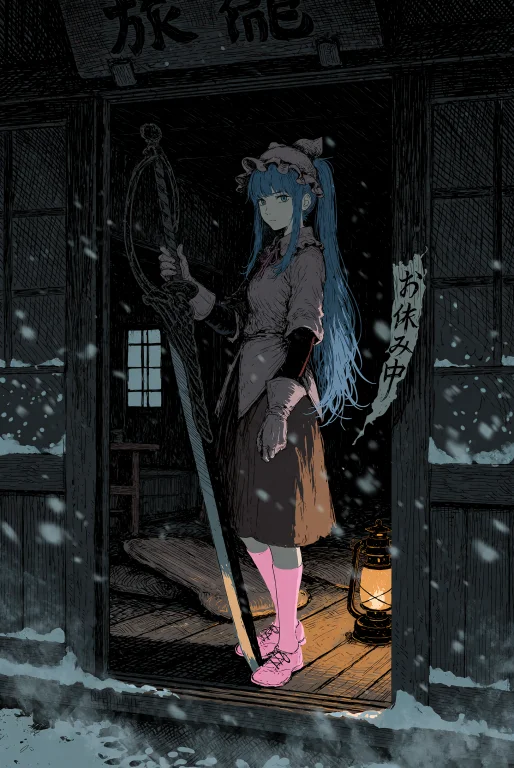
XIBALBA A cinematic anime film still rendered through rough woodblock-carved line — bristling jagged contours, impatient oekaki bite, edges that break and re-form rather than close cleanly — laid over a dusty, sun-bleached Edo palette pushed into a cyan night: indigo-black shadows, ash-grey snow-light, cold teal air, and a single warm amber pool where a lantern burns. A driving second architecture of extreme ink hatching and crosshatching runs across everything: dense parallel strokes crowd the shadowed wood, knot toward the corners, and resolve into ribbed, tendon-like, bio-mechanical rhythms of iron-and-sinew, while monochromatic near-black masses hold the frame. Two bold accents cut through like struck sparks — the lantern's hot orange and the flat candy pink of her socks. The dark gothic undertow lives in the treatment, not in monsters: the hatching itself grows toothy, maw-like, devilish up in the rafters. The subject is one young woman, solo, standing at the threshold of an abandoned roadside teahouse on a snow-heavy night, full body in tall vertical framing, turned three-quarter away and looking off-frame left, her gaze fixed on something the picture will not show. Long blue hair in high twintails under blunt bangs, sharp cold blue eyes. She wears a small frilled hat canted slightly off-true, gloves and dark arm warmers up both forearms, a plain brown skirt hanging heavy, pink kneehigh socks, and worn shoes. Her posture is a held breath: weight rocked onto the back leg, hip cocked, front foot just inside the door line. She grips the pommel of an absurdly huge sword planted point-down into the snow at the doorstep, its guard ribbed and welded with dark metal structure that reads as much anatomy as ironwork; one gloved hand closed on the hilt, the other arm hanging low with fingers loosely hooked in her skirt hem. The blade is taller than she is — a warning that arrives first. She stands in one coherent medium of cold air and dim lantern light inside the teahouse, near-empty, its furniture shoved and unmade as if nobody dressed the space for a picture, though one thing has been left deliberately wrong: a cushion turned over, one floorboard shining where every other is dust-dulled. Because the shutter stands open, a little weather is earned at the frame's edge — a thin drift of snow along the inner sill, a wet darker patch where flakes have already died, a torn paper notice curling off the door post with "お休み中" brushed across its face, the wooden hanging sign above the lintel bearing "旅籠" turned inward to the room it once served. Beyond the opening, the street holds its own cyan night and its own falling snow; inside, the air stays dry and still, dust motes hanging in the lantern column. Lighting comes hard from one side: a low iron lantern at her right throws warm amber across her cheek and the sword's flat, cutting a long nose shadow down her face so the near cheek is plunged and the far cheek stays open and cool-lit, with a clean bright edge riding the far side of her jaw and shoulder. Snowflakes drift in the extreme near plane at the open threshold, close enough to fall softly out of focus; behind her, detail collapses into hatched mass and blank paper-white bloom. Focus holds on her face, the hilt, and her hands; the room softens into rhythm and value, edges lost-and-found, and only the pink of her socks and the orange of the flame are allowed to burn. Small drifting details are locked: the frill on the hat's brim uneven by one fold, a doubled knot on one shoelace and a single knot on the other, the two socks matched but one pulled a shade higher, hatching deliberately breaking into open white along her hair. Composition is asymmetrical within the vertical, her figure set off-center against the black doorframe, the sword's length running as a diagonal through the lower third, the snow-plume of the near plane crossing the bottom edge. The finish stays print-like and matte — grainy paper tooth over flat ink blacks, controlled highlights without halation, woodblock roughness declared in every line, the whole frame breathing like a cut from a handheld, dust-lit film.