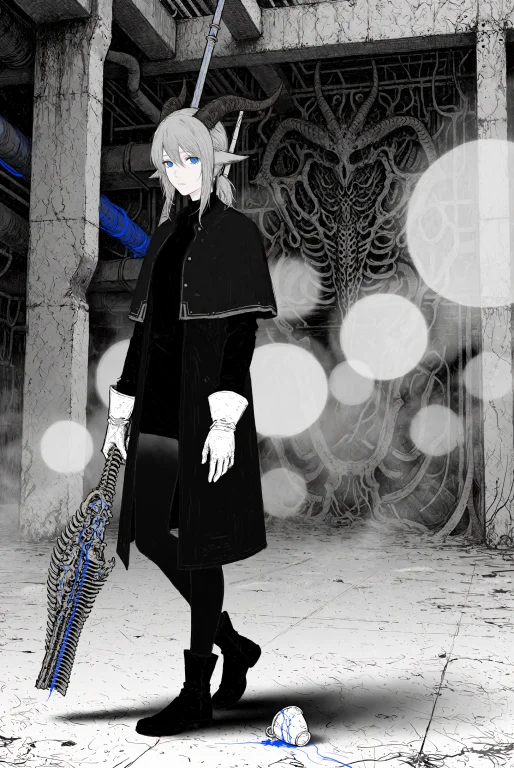
Xibalba. A Dense Monochrome Ink Illustration Built On Extrem...
Category: General | Model: Stable Diffusion
Xibalba. A Dense Monochrome Ink Illustration Built On Extrem...
Prompt Text
XIBALBA. A dense monochrome ink illustration built on extreme hatched and crosshatched linework, drawn in a bone-white, grey and black value world split by exactly one leftover color: a disciplined cobalt blue. One young woman stands full body, tall vertical frame, placed slightly left of center on a pale floor, her chin level and her blue eyes held directly on the viewer without any appeal in them, the look of someone whose pulse has already come down and who would rather be seen accurately than guessed kindly. She is small-framed and load-bearing: short grey hair swept into a short ponytail, straight sidelocks framing her face, a loose strand falling between her eyes, thin v-shaped eyebrows, pale goat ears angled out beneath two ridged goat horns that curve back over her hair like part of the skull's structure rather than decoration. She stands with her weight sunk into her left leg, right hip cocked a fraction, shoulders squared but unbracing, wearing a black shirt tucked smooth, a black coat hanging open down her sides so the shirt reads through the gap, and a short black capelet seated flat across her shoulders with a narrow gray-stitched hem. White gloves cover both hands to the wrist; her right glove grips a tall staff a third of the way up its shaft, letting it slant diagonally across her body so the blunt end hovers just above the floor and its bio-mechanical head rides above her shoulder. The staff head is the most intricate thing in the frame: a ribbed cage of bone and pale machined metal built from vertebrae-like segments and veined conduits, clamped around a thin cobalt filament of light, hatched in tight parallel strokes until the metal reads as machined and grown at once. Her left glove hangs loose at her hip, two fingers hooked under the open edge of the coat, holding it back, glove leather creased at the knuckles. Black thighhighs run up under the coat to a soft tonal edge, black ankle boots square on the ground, one foot turned outward. The room is an emptied industrial hall, clinical and gutted, walls of poured bone-white concrete veined with dark water stains, riveted girders, ducting and cable runs receding in tiers of crosshatched massing, and far back—half lost—an ironwork relief panel that resolves into a gothic devilish face of interlocking ribs and pistons, both machinery and anatomy. Haze hangs in the volume as a flat clinical fog that eats everything past the mid-ground. Behind her, defocused lights bloom so large they stop being lights and become weather: giant overlapping circles of pale glow drifting across the girders. On a steel step beside her knee, abandoned mid-sip, a chipped white teacup with a thin thread of blue riding the surface of the tea, the only tender gesture in the space. Lighting is a soft studio key from front-left that lands on her skin with even, luminous, almost too-perfect smoothness, flattening the coat into broad black shapes, with a cold rim dropping down the edge of the capelet and along the staff shaft. Value structure runs hard: her horns, boots and the staff head take the blackest blacks and the sharpest, most knotted hatching, while her skin, hair and the concrete behind her sit in stacked greys and the far hall dissolves into gestural hatch and lost-and-found edges. Absolute sharpness stays on the eyes, the glove seams, the horn ridges and the staff mechanism, then falls away into mass, gesture and defocused light. Cobalt survives in only four places—her irises, the staff filament, the reflection in the teacup, and one thin seam of light along a distant duct—and everything else in the frame has gone bone, ash, ink and industrial grey. A crisp offset contact shadow pools under her boots, anchoring the figure against the pale floor. The whole plate holds an athlete's stillness, privacy performed in public, carried and never carrying.