Xibalba. A Square-format 1950s Kodachrome Portrait Staged A...
Category: General | Model: Stable Diffusion
Xibalba. A Square-format 1950s Kodachrome Portrait Staged A...
Prompt Text
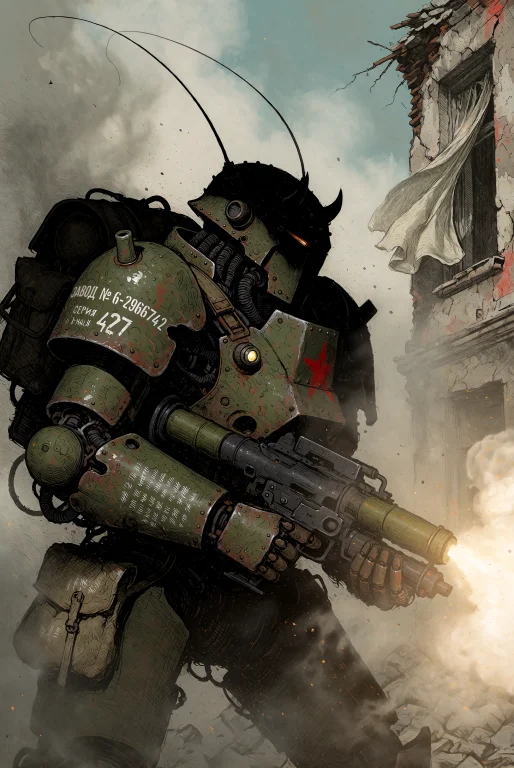
XIBALBA. A square-format 1950s Kodachrome portrait — staged and lit like a photograph, drawn as dark gothic bio-mechanical illustration — of a Soviet-built mecha combat unit: a riveted olive-drab power-armour soldier with nothing human inside it, framed chest-up and three-quarter from a slightly low angle, its framing and falloff built on an 80mm medium-format perspective opened to f/2.8, in the soft, generous, faintly overexposed daylight of a hazy overcast afternoon that saturates the plate to warm ochre and lets a mild halo bloom on every bright edge. The machine reads as a ledger given legs: heavy slab shoulder plates with rolled steel edges, a ribbed hydraulic column climbing the spine like an exposed ribcage, corrugated cable bundles at the throat, and a helmet cowl whose exhaust vents flare into a pair of horned, devilish gills. Two long whip antennae rise off the crown and sway. The shadow side of the head collapses into absolute ink black — a solid crosshatched void with no value left in it — so the face-plate seam, the sensor slit and one optic catch are drawn only on the lit side, where the metal carries fine dust, chalky oxidation and fingerprint-level wear. Its right hand is locked on the pistol grip, left forearm braced under the tube, mid-fire: a rocket launcher seated on the shoulder, muzzle flash washing a wedge of bleached white across the near plate, recoil stepping the frame, and a thick churn of cordite smoke rolling out in front of it and thinning behind. On the left shoulder plate a worn white stencil reads «ЗАВОД № 6-2966742» in chipped industrial Cyrillic lettering, and beneath it a second stencil, «СЕРИЯ 427», half-scrubbed away. Rows of tally marks are scratched into the forearm plate and into the shell of the armoured backpack — dozens of short paired strokes, unevenly counted, plus one blank column left unentered. A battered field ledger in a scuffed canvas sleeve is buckled to the pack's outer pouch, pages slightly swollen with damp, and the pack itself is strapped tight enough to pull the shoulder rig out of true. The setting is a ruined industrial street: broken façade, rubble and shattered kerbstones, all one volume of drifting smoke and dusty air. At the right edge of the frame, on the correct side of the wall, a cracked window stands starred and open in the plaster, and a pale curtain has been sucked outward through the gap into the street by the backblast, hanging caught mid-billow. Light is soft and directionless from above with a single warm muzzle-flash source from lower left; the palette stays monochromatic — olive, cold steel grey, dust ochre — cut by one bold accent red in a painted star stencil and a lit status lamp on the chest yoke, with a faint dusty cyan in the sky above the smoke. Perceptual hierarchy: the lit shoulder, the near antenna, the ledger pack and the stencilled lettering stay sharpest and most worked; detail dissolves into extreme ink hatching and dense crosshatching as the flank turns away from the key, so the far side and the helmet's shadow cheek become pure black mass with only mechanical contour held; smoke goes to soft, gestural, feathered layers; edges are lost-and-found, crisp on the focal plating, broken and grainy in the periphery. Composition sits the subject off-centre on the left third, weapon crossing the frame diagonally, smoke filling the right, the billowing curtain as an accidental grace note at the edge. Render it as soft-drawn Kodachrome tonal roll-off laid over dark gothic bio-mechanical illustration — intricate linework bitten into every plate edge, extreme ink hatching and crosshatching carrying the shadow structure, monochrome colour contrasts held tight against a single hot accent, the overexposed Kodachrome highlight glow kept as the final finish.