Xibalba. A Wide Panoramic Manga Panel In Obsessive Black-and...
Category: General | Model: Stable Diffusion
Xibalba. A Wide Panoramic Manga Panel In Obsessive Black-and...
Prompt Text
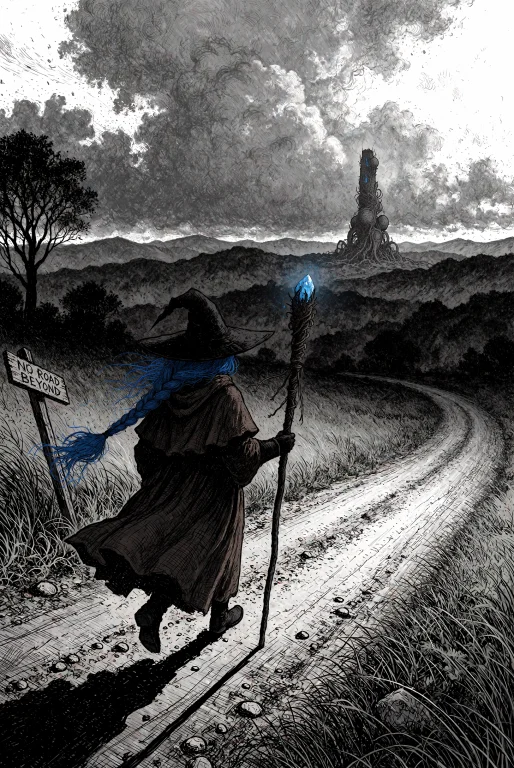
XIBALBA. A wide panoramic manga panel in obsessive black-and-white ink, executed with extreme crosshatching, stippled grain, and razor-fine linework that gives every surface a visceral, almost biological texture — the drawing style of a horror manga master turned on an open landscape, where a clear blue day is rendered as something quietly wrong. Center of the frame: the rear view of a short-statured adult demon mage walking away along a dirt road, viewed from behind in a three-quarter rear angle, face completely hidden beneath the brim of a wide black witch hat and turned toward the horizon. Long deep-blue hair flows out of the hat and is gathered into a thick braid that hangs down her back and sways mid-step, its last third loosening into stray strands. She wears a heavy brown hooded cloak, its hem whipping sideways and the folds resolved in dense hatch lines, and her right hand grips a tall gnarled mage staff — knotted wood, cordage wrapped at the haft, a crystal head at the top catching the light — planted forward as a walking stick rather than a weapon. Her left arm is tucked under the cloak; her weight is on the leading foot, right hip dropped, braid pulled off-axis by the wind, one boot lifting off the dirt in a stride caught mid-motion. The road is a pale ribbon of packed dirt and gravel curving toward the right edge, hatched into dry cracks and wheel-ruts, with scattered stones and a flat crop of wind-bent grass along the shoulder. Off to the left, a lone tree stands in silhouette, its branches drawn as a wiry skeletal claw. A leaning, rotted wooden signpost is driven into the verge facing the oncoming traveler — and therefore the viewer — with hand-painted weathered lettering on its board reading "NO ROAD BEYOND". Beyond the grass, the terrain rolls into a mountainous horizon built from stacked values, dark ridges behind lighter ridges, each range losing contrast into the next. Far off on that horizon stands a lone tower, and it is the wrongness at the heart of the picture: a bio-mechanical spire where masonry gives way to ribbed struts, tendon-like cables, and bulbous socket forms fused into the stone, hatched so densely it reads as both architecture and anatomy, with a faint unnatural glow leaking from its upper apertures. Above everything, a towering cumulonimbus fills the upper third of the frame, massed in stipple and fine crosshatch so it banks from bright white to bruised black at the base, while ragged smaller clouds streak across a sky that is otherwise clear. Lighting is harsh, low, and raking from the far right — the last hour before dusk — carving a long hard shadow from her boots and staff straight across the dirt, blowing out the sunward edges of her hat brim, cloak shoulder, and the staff crystal, and dropping the shaded side of her body into solid black masses. The palette stays monochrome throughout, and the one bold accent color is a cold cobalt-blue that lives only where it matters: the braid's mass, the staff head, the glow seeping from the distant tower, and the faintest cold bloom in the darkest storm base — a single chromatic thread stitching the whole composition together. Perceptual hierarchy: sharpest, densest detail clusters on the hat, braid, staff, and the hatched tower; the near road holds crisp gravel texture; the middle ridges simplify into broad brush-masses; the far horizon and cloud edges dissolve into stipple and broken silhouette. Lost-and-found edges dominate, with hard contour reserved for the figure's outline and the staff. Compose for a wide lateral frame with the figure placed slightly left of center on the rule of thirds, the dirt road carving a diagonal to the lower right, the tower small but unmissable on the horizon, and the storm massing across the top — held together by heavy black value anchors and the disciplined restraint of ink on paper.